Showing posts with label Sophia. Show all posts

Thursday, September 20, 2012

Braying Again

The Little White Donkey has been silent for a while.  Summer can be difficult here -- hot and humid, it is the season of short tempers for me.  I have been engaging in the mid-life wondering of where my life is heading -- including wondering 'do people REALLY want to read about my family (mis)adventures-- dealing with some physical issues (mysteriously torn shoulder tendons), and coming to grips with having only the boys at home.

Earlier this month, Sophia and I flew to Stanstead with RyanAir and spent three days in London preparing to launch her on her boarding school career.  Blessings on Michael and Tony, Sophia's UK guardians, who lent us their lovely flat above their gastro-pub while they were abroad.  Blessings to on my big brother and sister who came from Ireland to support me in shopping, eating, and bidding Sophia  farewell.  We did, literally, 'shop 'til we dropped' -- buying duvet and pillows, clothes (she needs a 'business suit' as, although there is no uniform for the Sixth Form, her school requires that she be 'interview smart' six days a week) for the English climate, toiletries and all manner of sundries.  John Lewis and the charity shops of Marylebone High Street saw a good deal of our custom.


By bus and train we lugged her two massive suitcases to Hook station, and from there took a taxi to her new school, Lord Wandsworth College.  Blessings on the weather, the sun shone and the sky stayed blue.  Matron made us tea which we had outside Sophia's House (for Madeira friends who are reading this, UK boarding schools don't have 'dorms' as we knew them, they have a more self-contained House system).  Then inside to unpack, and make the small
single room a little home-like.  I hung around for as long as I could, but there was no putting off the moment.  We walked back to the admin building, got staff to call me a taxi, and I left Sophia standing among all that green grass to do what she needs to do.


It was not a happy train journey back to London, but Ruth met me in the restaurant and we had a great meal -- better than Sophia who dined on frozen pizza amid a crowd of unknown faces.  The next day I flew home...


Sophia is working things out.  We have a Skype connection and speak most days.  She understands the International students sometimes better than the English ones, and thrives on the challenge of her studies: English Lit, History, Classics, Physics, and Critical Thinking as A level subjects, Russian as a language.  Her high marks and motivation have also landed her in a group that will be specially tutored for the Oxbridge entrance exams.  She wanted to do horse riding, and has managed to avoid the infamous 'Games' (such a staple of English boarding schools) but is swimming; and her Personal Endeavor is as a visitor in a local old people's home.  She has already asked if she can take part in the school trip to Washington DC next Easter...

She'll do just fine.


So I return to my mid-life crises -- running the house and the garden, playing chauffeur to the Littles (Alex has his driving license now, so is pretty independent), trying to keep up with photography.  I have been thinking about taking a Teaching English as a Second Language qualification, and also working at a dog shelter... so there should be some updates in the coming weeks.


Bray On, Little Donkey, Bray On!

Sunday, April 15, 2012

A Few Days Out


The Xynisteri vinyards around Laneia village where grapes for Commanderia wine are grown.


As we left the house heading for the mountain rather than coastal road to our rented villa, Sophia said “You realise that this will be our last family holiday?” referring to her leaving for school in England in September. But she was wrong. Our last family holiday was two years ago when we went to Italy – and this time was not all the family was present anyway. Best Beloved was away on a week's jaunt visiting friends in Berlin and London, and Alex 'didn't want to come.'

Family bonding over a game of Monopoly -- in Greek.  Sophia trounced us.

Realising that I would be working in the house, field, and garden without BB for the first few days of the Easter holidays, and knowing that I would also be fending the Littles off permanent computer time, I visited the websites that we had used to rent self-catering accomodation overseas to check what Cyprus had to offer.  I eschewed the plethora of seaside villas with pools in Paphos, and chose a three-bedroom house in Lania, a hill village not far from Limassol. A quick call from the owner in response to my email confirmed that it was available for three days, and we left as soon as school was over last Friday.

Lania is an artists' roost and a stop on the tourist trail. Every street and lane in the village seemed to have a studio or gallery, but despite the Easter preparations, the narrow lanes were very quiet and we wandered for a while. Sophia and Leo soon got fed up and went back to the house, but Zenon and I explored the playground and the cemetery ('Let's see if we can find the oldest person buried here, and the youngest!' -- we did), and found the rough and ready football pitch.

The trail-head... Not realising that there was so much snow, I had planned a hike... Oooops!

The next day I gave them a choice of driving up to Troodos or over the hills to the village of Lefkara, and they unanimously chose Troodos. I planned to walk the circular trail around Mount Olympos, but we found the trail-head under a metre of snow. “Can we hire snowboards at the club, Mum? Can we, can we!” Sophia groaned – she was wearing three-quarter shorts and hadn't brought a jacket – but when I said yes to the boys, she shrugged and grinned and said “Guess I have to get used to this snow stuff, huh?” and proved adept at jamming feet into boots and doing and undoing bindings.

Leo got the hang of snowboarding quickly.

Nobody takes snow sports seriously in Cyprus. People hit the slopes for the novelty of it without proper gear (yes, you can see women teetering along the slushy paths in stilletoes and we parked the LandRover beside a pair of elegant leather brogues either forgotten or ruined and discarded) or any idea of how to use their rented equipment, and we were no exception. Few people shared the piste with us: Cyprus has had so much snow this year that the novelty has worn off, and even a brilliant Saturday tempted few punters.

View from the top.  The slopes were empty, considering that it was Saturday.

The boys took a while to get the hang of snowboarding, but they stayed for hours with only a short break for an overpriced lunch at the cafe. We would have stayed longer but I took pity on Sophia for her barked shins and sopping feet, and we left at about four. Leo went down from the top of the slope and came to grief through no fault of his own when a skier fell in front of him, but Zenon was more cautious, and having seen the view from the top, opted for a lower starting point.

Zenon's descent from near the top.


On top of Olympos.  Sophia was not the only one unsuitably dressed for the snow.

The next day we went to Lefkara by backroads. I had printed a map from the Internet and traced the line linking the villages through which we had to pass. Handing it to Sophia, I said “Shotgun? Navigator!” and she replied after a quick look: “That's easy, turn right at Trimiklini and keep going...” I kept my own counsel, but thought it might be a bit harder than that.

Heptagonia cemetery.  We stopped here because the church roof was tiled in the old style, and I wanted a closer look, but Zenon found the grave of a very old man.

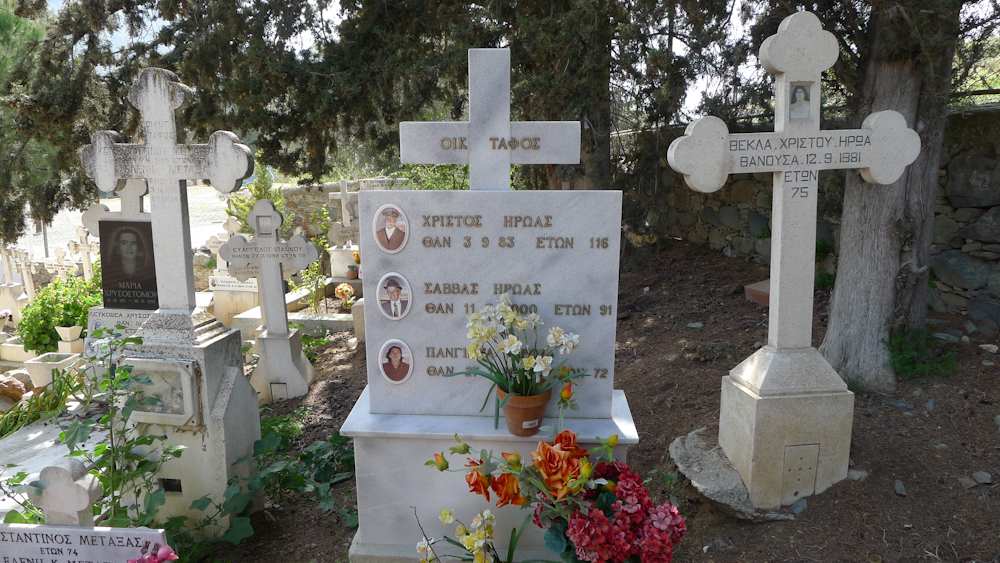
A few kilometers out of Trimiklini, we passed a turn to Kalo Horio. “Do we go there?” I asked. “No,” she replied. “We go straight.” I told her to check again. “No! We need to turn! Go back!” What looks straight forward on Google maps translates differently in the Cyprus back-country... In fits and starts, asking directions in coffee-shops and with several wrong turns, we found Lefkara two hours later. I had wanted to show my children something of the reality of their country, away from the touristic and Anglicised conformity that characterises Paphos, and the drive to Lefkara – over gravel roads and through a quarry (“How many of the machines from Giant Earthmovers can you identify there, boys?”), through villages were two cars cannot pass the roads together and where happy locals are sipping Zivania long before noon, stopping to visit a cemetery where Zenon found the grave of a 116-year-old – did that. It reassured me that the country that I had criss-crossed alone on a dirtbike twenty years ago was still very much alive in its idiosyncrases despite induction into the EU and Eurozone, and when I met Chrystalla Komodromos, the lacemaker whom I had interviewed twenty years ago in her Lefkara shop for an article in the Cyprus Airways in-flight Sunjet, I felt that a circle had somehow been closed.

Chystalla Komodromos's handmade lace and Lefkaritiko at her Alley Shop in Pano Lefkara.

The children were a little grumpy by the time we found Chrystalla. A snack had revived them, and the village's twin crafts of fine needlework and silver smithing had caught Zenon's fancy, but many of the shops and all of the metal workshops were closed and tramping the steep cobbled streets was fraying their nerves. Leo didn't let me chat to Chrystalla for long – he kept fiddling with her display – but I decided to come back for a longer visit soon, and to bring my mother's silver hairbrush for repair in a workshop there.

We were all hungry by the time that we reached Maria's restaurant on the road to Vavatsinia, and we were the only customers in the huge, airy room that could easily seat 200. Lunch was fresh, local, and delicious, served by Maria herself, and we spun it out over a leisurely hour and a half enjoying the view over the valleys and lighthearted banter with the family.

Lunch at Maria's on the way to Vavatsinia.

The road home was a little faster as we knew the way, and the boys headed to the football pitch for a kick-around after sitting for so long in the car.

The local football pitch.

I had planned a visit to Limassol for the third day: a visit to the castle and the Turkish Quarter where I used to live in a cheap hostel, a walk along the water front and the old shopping street of Agios Andreas, but Sophia and Zenon were desperate to try ice-skating at My Mall, and, once there, I could not face the battle through town traffic again. I caved and we spent two-and-a-half hours at the mall. A leotard-and-floaty-skirt-clad ten year old (“I'm here skating for hours every single day!”) took all three under her wing, dispensing instructions and admonitions with pursed lips and plenty of head-tossing, and by the time we turned in the skates and headed for lunch, Sophia had mastered turns and skating backwards, Zenon was whipping around the rink – comfortable going forwards, but not yet able to turn, and Leo was fairly proficient. All three had a liberal ration of cuts and bruises, Sophia the worst off – a skate blade had cut her leg quite badly and she had also managed to run over her own thumb.

Skating at My Mall.


This little girl, fluent in Greek and American accented English helped Sophia, Zenon, and Leo to master their skates.


By the time we went for lunch, Sophia was getting pretty good and the others were comfortable.

We weren't sorry to get home later that afternoon. The holiday had served its multiple purposes – a break from routine, a celebration of the end of school – for now, a visit to hitherto unknown parts of the country. But plants needed to be watered and Alex had reported that the dog had been depressed since we had left. Time had come to pick up the threads again and begin the run to the Easter celebrations and Zenon's twelfth birthday.


Sunday, March 25, 2012

Sunday walk: Along the River to the Sea


For weeks, I have wanted to walk our river to the sea. Best Beloved and I planned it as a family outing last week but it didn't happen: this Sunday, nothing stood in my way. At just after eleven, Sophia and I loaded the two dogs and the Littles into the Land Rover and set out for the other side of the bridge.

The water level has fallen a lot since the dam overflowed two months ago, and soon only a chain of muddy pools will lead from spillway to the sea. Then those will parch under the summer sun, and the river will be just a memory for the next decade or so.


We couldn't follow the water. Mud, impenetrable thickets of weeds, and bulldozered channels and rises stood in our way, but we picked our way along a track under the motorway bridge until we found a clutch of bee hives tended by their white-suited keepers, then around the edge of a potato field, through a barnyard, deserted but for a couple of chained dogs, along an asphalt road bordered by olive and citrus groves and to an area of greenhouses where Vietnamese workers in conical hats picked peppers.


 Fly-tipped rubbish and river refuse blighted what would otherwise have been a beautiful walk, but flowers made everything bright, and the dogs dashed in and out of the fields searching for mud puddles and sniffing the exciting smells of spring countryside. Frogs serenaded us from the water below, and I wished that we could have found a way down so that I could have initiated my children into the delights of raising tadpoles.


After a burned out car and a wrecked BMW with a sloughed snakeskin on the driver's seat, the asphalt became a track that led us past other fields, the river on our left, to the sea. Neither dog had been to the beach before, and Sophia conned Lucky into swimming by tossing a rock into the waves. Once bitten, twice shy – she refused to go in again. Sputnik tried drinking it, but gave that up as a bad job with a dismayed expression on his face.


Despite not feeling well, Zenon enjoyed the walk. Normally he would have thrown himself into the spirit of our quest for a path to the sea, ranging on each side as a scout, hunting Orcs or other creatures, but a lingering cold made him more subdued. But “Can we do this again next week, Mum?” he asked as we reached the Land Rover on the way back. “I've had a really good time!”  Leo was more inclined to be negative, but I have the feeling that if I suggest another walk next Sunday, he will jump at the chance.

Wednesday, March 7, 2012

A Visit to the Vet


After his week's elope with the Siberian beauty, Sputnik returned home thinner, dirty, and scarred. He had been staying at Cuz's Supermarket at the end of the road, but although we had tried several times to bring him back, he always found a way to return to his lady, the Ice Queen – so we let them be in their love nest between the gas bottles and the water tanks.

The Acolyte's blood had come off, but he still had some oil stains on his coat. “You should see the back of the supermarket,” Sophia said. “It's disgusting. No wonder he's filthy!” He had a bare patch on his hip, his ears had been bitten, and he had a cough.

“Dissolute living!” I told him as I poured his breakfast kibble. “There's always a price.”

But when Sophia noticed a trail of bright red blood under his tail after yesterday's walk, I decided that the time had come to visit the vet.

“Which vet do you use?” is a constant topic among Paphos pet owners. After much trial and error, I have cast my lot with Paphiakos who also run the largest animal welfare in the district. They are open 0700-1900 every day of the year (although clinic hours are shorter), have bi-lingual staff, clean premises, a tea-room, and plenty of love to go around. Also, their prices are well within the reasonable range.

We arrived at 8.40 and spent the twenty minute wait in the tea room with two enormous cats, two nescafes, and thick slices of banana nut loaf. Overwhelmed by his ride in the back of the Land Rover (“Mum, do you think that Sputnik hates cars so much because he associates them with having been abandoned on the road, probably from a car, and he thinks that we're taking him somewhere to dump him?”), Sputnik didn't know what to do with himself: he had to smell everything at once, to see everything, to investigate the cats, the cake, the outdoors.

The vet gave him a thorough examination, and pronounced him 'healthy, but a bit run down' when we told her of his escapades. “He's been very stressed, very excited,” she said. “He didn't eat well while he was away, and his immune system suffered.” (Why does that remind me of another adolescent male that I know?) “That's why he has an overgrowth of skin parasites that are normally present but controlled.”


“I don't want to put him on anti-biotics for his cough,” she continued, as his lungs are clear of fluid. “But if you notice that it gets worse, that he stops eating, or see more blood, bring him in again.” She gave me a worming tablet for him, and instructions for a thorough bath.

On the trip back he looked out of the window with interest rather than angst, and sprawled on the floor of the back while I nipped into Carrefour to see if I could find any gloves for the Littles (I did – the last two pairs of a size that will fit). When we got home, Sophia bathed him – to his disgust – and he's now sleeping in the sunshine.

The bill – for half an hour appointment with a full examination, two diagnostic tests (fungus and parasites), and a worm pill? Forty-six Euros. Seemed reasonable to me.


Sunday, February 26, 2012

It's a Dog's Life... and Death


A stray aristocratic-looking husky bitch that Sophia and I dubbed the Ice Queen showed up last week at the Cuz's supermarket/cafe at the end of the road. In itself, that is not a problem – except that she's in heat. And that, like a magnet, draws all the stray male dogs in the area – and our Sputnik.


And that is a problem.

They trash the gardens, they pullout the garbage, and they create a hazard on the main road – which is dangerous enough where we are. They also run the risk of catching a bullet from one or another of the armed characters up here including my husband and his brother.

So four days ago, along with Stelios who was working for me for the day, Sophia and I set out to capture the Queen and her Main Acolyte, a young chestnut brown labrador-pointer cross with a sweet face, and take them to the shelter. The husky may well be chipped as they are quite valuable here. The Acolyte was a dog no-one wanted: beautiful but whip thin and shy as a fawn. I'm sure that he had been beaten by the way that he cringed when anyone turned in his direction or attempted to approach.

I had seen Sputnik, the Acolyte, and the Queen in the dirt lot behind the cafe, so – armed with leads and some leftover hamburger – we piled into the Landrover. The dogs were there, and Sputnik ran to us with a smile: “See my new friends?” The Queen immediately went to Stelios, and we were about to get her into the car when the waitress from the cafe came out. “Where are you taking that dog?” she asked in broken Greek.

“To the shelter,” I said. “And this one, if we can catch him”

“Are they yours?” she asked.

Turns out that Cuz had claimed the Ice Queen.

“That dog is so not his,” Sophia said to me in an aside. “He just wants her because she's pretty and valuable!”

Cuz muttered something about a friend of his coming to take her and I said, with emphasis: “Cuz, she's female, and unless you keep her tied up, she's making a problem for all of us up here. I'm not going to shoot her, but Bill or Best Beloved might. Keep her on your place.”

On the way back to our house, I found the Acolyte – alone for the moment as Cuz had taken the Queen. I tried to make friends with him with a view to catching him and taking him to the shelter, but though he ate some chunks of burger from my hand, I couldn't touch him, let alone get him into the car, and I had no time to construct a trap and lure him in to safety. I had to trust that Cuz would take the husky home and that the problem would be solved.

Of course he didn't, and of course more dogs kept arriving. Then it was Bill's turn. “If it's your dog, Cuz, keep it off my place and away from my dogs. I keep finding piles of crap on my lawn...”  Cuz gave him a different story about the dog's ownership, but Bill cut him short.  "Just keep her under control."


Then last night: “Bill shot the Acolyte,” announced BB. Sophia and I exchanged pained and guilty looks. “And you'd better keep an eye on Sputnik because if Cuz doesn't keep the Husky under control, she might be next, and good shot though he is, Bill might miss. Among milling dogs, it's easy to hit the wrong one.”

Sophia immediately went to find Sputnik. “He's covered in blood!” she said.

“Well, he was close. As I said, keep an eye on him.”

This morning, Sophia went to find Sputnik to wash and feed him. He was at the cafe, sleeping curled up next to the Ice Queen. She prised them apart and carried him home: “He was crying his eyes out all the way,” she said. “The Queen was tied, and she was yipping and crying at the end of her chain, she would have followed if she could. I couldn't get all the blood off, Sputnik wouldn't eat, and as soon as he could he went back to the cafe.”

They're fine at the cafe, as long as the husky is tied or confined. She'll be out of season soon and the problem will end – for the moment. But if she is allowed to be loose and another swarm of dogs gathers, Bill is sure to shoot more of them. Strays are a real problem here, and although I do my best to take the ones that I find and can catch to a shelter – I've taken at least eight in the last year – there is no sign of a let-up.

Above pictures are not mine.  They were found on the Internet.

Tuesday, January 17, 2012

Daisies, Pearls, and Mushrooms – Adventures in Language Learning


Shortly after I began Greek lessons, I arrived at my mother-in-law's house and asked where my rooster was. Somewhat baffled – probably because although she has a rooster, I don't – she told me that he was in the cage. I said that I had something to tell him when he came out. Because my in-laws have always regarded me as a somewhat bizaare addition to the family to be humoured rather than confronted, she played along and said something like 'ok, but that probably won't be for a while'.

“Why?” I asked.

“That's where he lives... Has always lived...” Which is fine – for a rooster. Except that I hadn't meant to ask for my rooster, I was looking for Phil. But the word for father-in-law, 'petheros', had become entangled in my newmother-newlanguage-newcountry brain stew combo with the word for rooster, 'petinos'.

Similarly, I once told her I was going to the 'man-seller' ('anthropoleio' – no such thing exists, of course; slavery being a thing of the past, but an 'anthropoleio' would mean 'man-seller') for a bouquet instead of to the flower shop ('anthopoleio') and that I was cooking a suburb of Nicosia ('Lakatamia') for lunch with beans instead of chard ('lakana'). An Irish friend once told her mother-in-law that she would prefer some winter (she mixed up 'himo', juice, with 'himona', winter) to a glass of grass ('krassidi' as opposed to 'krassi' meaning wine)... The stories are legion: any readers with stories of their own of language misunderstanding in multi-lingual households, please share them in the comments section...

Mili and I often bond over language issues. She recalls the time that she urged an Anglophone friend not to pick fruit 'before it's raped', and always has to think twice before talking about heavenly bodies: she's likely to call them 'stairs'.

When Li'l Bro and Bridie visit, talk always turns to languages because they're both interpreters. Two weeks ago, I came into the house singing, while LB was sipping wine with Best Beloved at the kitchen table. “Then mporo”, I warbled. “Na se psegaso, prospatho...” And I saw LB's eyebrows climb toward his hairline. “'I can't spray you'?” he asked. “Are you sure about that?”

I had started having to master the vocabulary for sustainable agriculture about the time that Notis Sfakianakis' album 'Enthymio' was popular, and one of the oft-played songs included the lines that translate to “I can't forget you, (though) I try.” Trouble is, 'xehaso' (the subjunctive of 'forget') sounds very similar to 'psegaso' (the subjunctive of 'spray'). Of course I had known, but the idea at the time of serenading my trees and vegetables to confirm that they would be allowed to grow naturally was too good to pass up. The song remains forever in my mind linked to organic agriculture, and thus I continue to sing it – at least around Asproulla-friendly personnel.

Yes, the vocabulary of sustainable agriculture can be a minefield: during an early visit, the organic inspector advised me to plant vetch as a green manure to enrich the soil.  While telling Mili, before my visit to the seed shop, I mistranslated 'vetch'.  "He said I needed vitsia," I told her as we drank our coffee on the verandah.  Her expression became one of alarm, but I rattled on.  "Do I just go to the shop and say 'Thelo vitsia?'"  I thought that the coffee was going to come out of her ears, and my father in law convulsed beside her.

"Uh-oh. What have I said?" I asked in English.

"'Vitsia'" began my mother-in-law. "Is sex with whips and chains and..."

"Kinky stuff!"  Phil helpfully supplied.  "The word you want is 'vikous'..."  OK! Glad I asked...

Image courtesy of Micheal Palmer
 http://Greek-Language.com. 

“Ah, yes,” Mili mused in a mixture of Greek and English. “We call these mistakes 'margaritaria' ('pearls') because they're treasures!” I looked out onto the spring-carpeted field nearby and saw daisies 'margaritas' and thought that the conversation had turned again to flowers – where it had been a few minutes before. Gamely we struggled on, with me talking about flowers and her talking about pearls... until somebody brought in a basket of mushrooms. “Manitaria!” She exclaimed. And began rhapsodising about mushrooms. About that time I realised that she hadn't been talking about daisies in the first place...

Not too long after that, I was gleefully telling somebody that we had 'Chelones' (turtles) nesting in our courtyard when I meant to be talking about swallows ('Chelidonia').  But it's all part of being a foreigner and embracing a new language with a new life.

Things are better now, but Best Beloved and Sophia still nearly pee themselves over my Greek mistakes, and Teacher Kyriaki manages to keep a polite straight face: she's too professional to lose it even when I really drop a clanger.

Monday, December 5, 2011

Sophia and the Thai Cookbook


A few Saturdays ago Sophia, sitting at the kitchen table drinking morning tea, gestured at the cookbook shelf saying: “Mum, please put that Thai cookbook away. It reminds me of the lovely food that we had at the Chilli Pad in England last month...” And I said: “Well, why don't you have a look through it and see if there's anything you'd fancy making?”

“Is it that easy?” she asked. “Can we get the stuff here?” Sophia has never displayed culinary tendencies – or even interests – before, although left with detailed instructions, she has been known to produce a roast chicken in my absence.

Mili had given me the book, Stylish Thai in Minutes, several Christmases ago, and although I had flipped through it drooling slightly, I had never used it.

She took it down from the shelf and quickly established that we had 'the stuff' for Barbequed Prawns on Lemongrass, “If,” she continued “I can use a griddle and don't have to light the foukou.”

“Yes,” I said. “That is indeed possible.”

So we had prawns on lemongrass skewers (“I am never harvesting lemongrass again!” she harumphed, emerging from our clump with cuts to face and hands from the razor-edged blades) for brunch that day. A few days later, the boys being at school and Best Beloved at work, she produced fried meatballs with a tasty blend of fish sauce, coriander, onion and garlic in addition to minced beef (“These are just Thai keftedes!”) for our midmorning snack. And now that I have found Spring Roll wrappers, I'm sure we are on our way to something else.


“I'm not quite ready to start on the main courses yet,” she said. That's ok, Sophia. We're all enjoying the appetisers...

Thursday, August 18, 2011

Black & White

I'm trying something new here, linking to a blog called The Gallery which I found through another Cyprus blog, Emma's A Matter of Choice.  So The Little White Donkey will continue to chronicle the ups and downs of Family Life in Rural Cyprus (as it says in my header), but will also be navigating other photographic routes as well...

The Gallery's prompt this week was Black & White...

***


Yioti, my friend's son, had his fifth birthday party thirteen years ago, and his mother made him a number cake -- chocolate, with smarties.  Yioti's older brother is looking on in the snake t-shirt, and the little girl in the middle is my daughter.  The lady at the side is another friend.

How time passes -- how things remain the same!  Sophia is planning to go to England for her A-Level studies next year.  Yioti came by for a meal last night during a brief break in his mandatory Army service, Stelios was here over the weekend -- also on a break from the Army.  Six months ago, my middle son celebrated his 11th birthday, and the same characters were in shot -- but it wasn't a black and white picture, so we'll have to wait for a new prompt to see that one!

Tuesday, May 31, 2011

Spider- Catcher Extraordinaire

What would I do without my daughter, Sophia 'Spider-Catcher'? I was just putting Leo to bed: “Pick up your dirty clothes and put them in the washing pile, and take that”, I pointed to a towel that lurked damply in a corner, “and put it in the bathroom.”


Leo did as he was told and a large grey tarantula (or 'migal', I think they're called here – anyway it was a couple of inches across and all legs and hair) landed from the towel with an almost audible 'plop' on the floor.


I don't like big spiders. Unable to stop, I once drove the pot-holed dual carriageway from the Golan Heights to Damascus in the dark, a large spider patrolling the van's windscreen in front of me. Ducking my head, I managed to keep it in sight, backlit by the headlights of oncoming vehicles, and only when we arrived at the Damascus campground could Barbie, my travelling companion, and I try and catch it. No way were we going to sleep with that monster. We lost it in the van's bookshelves, and ate dinner with a weather eye cocked. Only as we were about to sleep did it reveal itself, an inch or two from Barbie's nose. She, fortunately, was made of sterner stuff than I, and managed to corner it in a glass, slide stiff paper underneath it, and fling it out of the van's sliding door – only to have it jump on her and run up her arm before it disappeared forever.


Sophia is also made of sterner stuff than I and has several times come to my rescue when a big spider has found itself near me. They seem to like damp laundry, especially towels. More than once, while picking up the laundry by the back door, I have had a big migal fall out of the pile. Early one school morning two years ago, it happened just before everyone was supposed to get up. I screamed from surprise and pain (it was the period when my hip was giving me real gip, and the sideways twisting leap that I performed in the pre-dawn gloom was guaranteed to hurt). Sophia heard my yell and turned over sleepily thinking 'Alex will sort it out, he's nearer!' When evidentally no help came from the gallant Alex, Sophia dashed outside to find me crouched and groaning, pointing at the offending arachnid. She promptly dropped a laundry basket on it, earning a reprimand from me... From then on, like Barbie, she scoops them up tenderly with a glass and a sheet of card and carries them far from the house.


Last winter, while taking a shower when the kids were at school, I reached for the soap and thought 'That's odd: one of the kids has left one of the plastic spiders from the Early Learning Centre in the soap dish...' only when I touched it and it moved did I realise that the creature under my hand was, in fact, real. I continued my shower, gaze fixed on the soap dish, but when I returned to remove it, the spider had vanished. For the next week I conducted myself with great trepidation in the bathroom – carefully inspecting all towels, face cloths, soap, and such. But it never revealed itself again.


So this evening, when Leo and I froze staring at the creature on the floor, I yelled for Sophia and she came, glass and card in hand. This spider did not go gently, however. S/he seemed to fancy Leo's room and only after much persuasion with the card and a wand from a box of magic tricks would consent to be lured into a position where Sophia could lower the glass over her/his body without trapping the great hairy legs.


Sophia's language was colourful -- a steady stream of epithets mixed with cajoling encouragement. Study of Shakespeare seems to be paying off.


Wednesday, January 26, 2011

School Crisis

School is once again at crisis point. The Big Ones are at a private English language school, and have been for the last five years. In that five years we have seen the head teacher change four times and the premises change three. We have stuck with the school for two reasons: there is little choice, we were holding out for the move to the new campus – hoping against hope that all the promises we had heard would be fulfilled.


Each year the fees have gone up. September 2010 saw Secondary moved to a private afternoon college's building because the Department of Education revoked the license due to unsuitable facilities. We watched the new school a-building down the road with scepticism and trepidation – how could it possibly be ready in time?


It was ready – well, sort of. Classes started in the building site, but there were no electricity, no internet, no blinds on the windows, and none of the whiteboards, computer facilities, science equipment that we had been promised. Chemicals for the science labs were ordered two years ago... but they haven't been paid for yet, so students learn their chemistry and physics 'theoretically', without ever performing experiments.

The last days of summer saw the students sweating in glare-boxes, and winter finds them shivering now that the 'solar gain' of this, Cyprus' first ecologically designed 'green' school, fails. A directive has come down 'No hoodies or sweatshirts, scarves, or non-uniform jumpers.' ('But it's cold and the uniform's inadequate!' the children wail.) Oh, and there's still no electricity apart from the generator: something about the Electricity Authority saying that the school must pay for a sub-station, or the Church (who own the site) saying that the school needs to pay more. So the bargaining continues. And, no, there's no transparency, either.


When time came to choose courses for this year, Alex, in his second year of GCSEs managed a workable schedule, and seems happy enough with his course load of maths, sciences, and ICT. Sophia, beginning her GCSE's, was unable to take French, art, or Greek due to scheduling SNAFUs. We have to do those subjects out of school hours because she enjoys them and thus excels. She is less fond of biology and economics – classes that she had to take because of the aforementioned SNAFUs – not because she doesn't like the subjects, but because the teachers are way below par. All last year's biology students – who scored A's and B's on their mock exams – received D's and F's on the real thing: a reflection of poor teaching, and the cause of much angst and devastation among parents and students.


“I started the year determined to work even if the teachers were incompetent,” Sophia said during a tempestuous family discussion last week. “But I can't because I simply don't have time.” Her other extracurricular activities include Taekwando and swimming. “Even if I see the past papers, I am simply not getting the kind of feedback to know if I'm doing the right kind of work!”


Then, one of her two good teachers left just before Christmas. Despite being a department head, he was still on a temporary contract; his wife, also a teacher, was verbally abused by the head of the Primary School; and his children were refused a discounted education despite both their parents being teachers. No wonder he took the High Road and elected to join the ranks of the unemployed when his wife was offered a first class teaching package in the Gulf. His replacement, a young woman, cannot hold a candle to him.


So I am off to see the headmaster this week. I like him and feel sorry for him: he seems like a capable, competent, hardworking and genuine man, but I think that he is being messed around by the directors and will probably not last even the two years that his predecessor managed. I'm going to complain – not because I believe that it will do any good, but because more voices of dissent need to be heard. Those of us who have stuck with the school are really fed up.


In the meantime, Sophia is investigating boarding schools in Britain, and salivating at what she sees. She cannot change for September 2011, but can apply for 2012 when the GCSE course is over. I had my doubts when she broached the subject of leaving, but when we discussed it in depth, I realised that her conclusions mirrored my own when I was fifteen and knew that I would have to leave Hawaii or sink academically, emotionally, and socially. I wound up at Madeira, and never regretted my decision.

Thursday, November 11, 2010

White Poppies for Peace

Sophia has been going to school with a white poppy in her blazer lapel. Far less widely recognised than the red poppy sold by the Royal British Legion in the weeks before Armistice Day, the white poppy is a commemoration of the innocents killed in war and a commitment to strive toward the non-violent resolution of conflicts and an understanding of the causes of war – in order to better avoid it.

One of the premises of the Peace Pledge Union, the oldest secular pacifist organisation in Britain and purveyor of white poppies, is that the general (in our society) assumption that ‘a little violence’ can be a useful tool – is a grievous mistake. Reading about the background to the sale and wearing of white poppies has given me tremendous pause for thought over recent days. Violence is endemic in our society – from the very basic level of the family, through the state and to the international arena.

I was brought up with the idea that violence, judiciously used, was an acceptable means to an end. If we didn’t behave, my siblings and I were punished with our pants swiftly pulled to our knees and a few hard applications of a wooden spoon or a bare hand. Later, my mother took to slapping me across the face in order to curb my ‘dumb insolence’. Her father had been a captain in the Royal Navy -- and had abused both his wife and his children. She had no other paradigm for parenting. As far as I know, such punishment was the norm in my friends’ families, too.

I have no other paradigm for parenting either, though I have read of families who manage to maintain discipline and harmony through mutual respect, whose parents say that they could never imagine striking a child.

But I have smacked my children: the older ones swear that I hit them more than I do the younger ones, and I’m sure that they’re right. But as I have matured, both as a person and a parent, realise that a smack – or the fear of one – doesn’t work. And do I want my children to live in fear of my smacking them? Would I prefer that their behaviour were governed by understanding and respect, or by fear? I firmly believe that my Best Beloved’s raising his hand to me would be the only reason for me to pack my bags, so how could I possibly consider spanking my children – so much smaller than I, so much more fragile… and so trusting.

And, worse, I see the older ones following my example: if the Little Ones’ behaviour becomes too annoying, a smack from one of the Big Ones (despite their having been forbidden to strike their siblings – justify that, will you: ‘I can hit someone else in order to impose my will, but you can’t’) will soon follow.

Violence, even on the micro-family level, begets only violence.

And as happens within the family, so happens within the State, and so happens between Nations. Change things at the family level and at the community level, and grows the chance of a paradigm shift at a higher level. Once again we return to Gandhi’s oft-quoted remonstrance to ‘be the change that you want to see in the world.’

A friend of mine, a former Army helicopter pilot once told me (in response to my saying that I ‘would try to get’ something done) ‘There’s no ‘trying’, Asproulla. There’s doing, and there’s not doing.’ So from now on, I pledge to renounce violence as a means to and end, and to work on conflict resolution by peaceful means. One Day at a Time.

To do so is the only way to honour the white poppy in Sophia’s lapel. All else is lip service and window dressing.

Tuesday, August 3, 2010

The Larks, Still Bravely Singing, Fly

Our bikes – big sturdy 21-speed touring machines complete with carry tray and bungee on the back, lights, and padlocks -- cost 10 Euros each per day and we arranged to have them until 7 p.m the next day. We wobbled off (I hadn’t been on a bike for25 years and the others, although more familiar with two-wheeled transport, were unused to riding in traffic on the wrong side of the road) following the route marked on our maps and signposted by red hexagons every couple of hundred metres.

We did the southern part of the route that first afternoon, the hexagons leading us past several cemeteries and the memorial at Hill 60 to the main road between Menin and Ypres (I’m using the old spellings here – since this area of Belgium is Flemish speaking, the French names have been replaced, but as we were here on a battlefields’ tour, I will use the more familiar spelling from days gone by). We stopped and wandered among the graves, reading the names and the ages, feeling the deep peace that settles on such places, enjoying the flowers.


Padlocking our bikes we wandered among the shell holes that still pit Hill 60, tripping over iron embedded in the earth and skirting the brambles that climb over a collapsed dug out before reaching a main road that led back to Ypres. Realising that we had missed the museum and trench systems of Hill 62, we decided to cut the day short and go back to Ypres for a meal and a rest, catch the train back to Poperinge, then make an early start the following day and ride the rest of the route.


Arriving at the station, we found the train delayed by more than half an hour.


‘You can leave your bikes in the lock up over night or take them for 5 Euros each,’ the station master told us. ‘But why not just ride back? It’s only 12 kilometres and you’ll probably beat the train.’


We did that, but unlike all the other roads we had been on, the Route Nacional to Poperinge was not bike friendly. Halfway there we passed a sign saying that bikes were not permitted on the hard shoulder, and twenty-ton international lorries hurtled beside us. I cycled behind Alex and Sophia wondering what I would tell their father if I lost them to traffic. As we pulled in to Talbot House, Sophia turned to me: ‘Just so you know,’ she said. ‘I’m not riding into Ypres tomorrow morning!’


The next day we were all feeling tender. Muscles long unused protested, seat bones felt bruised. We took the train back to Ypres and set out for Hill 62.


On the way, Sophia decided to get to know the cows. ‘We don’t have cows in Cyprus,’ she said, dismounting her bike and approaching a small herd, camera in hand. We do, of course, but not cows like these. Cyprus cows are kept inside, and rarely seen. They’re smaller than the great Friesians and Charolais who approach eagerly, lowing and licking their noses with great rasping tongues. Sophia was entranced, but I could not let her linger. We had miles to go and had to have the bikes back by seven.


Hill 62 has a partially restored trench system and a chaotic museum, but was well worth visiting. I wish that we had brought torches, and were wearing sturdier shoes as many of the dug-outs are still standing and safe to enter, although dark and muddy. From there we cycled back to the main road, up to the memorial at Polygon Wood and into the village of Zonnebeke.


…Where we got lost. Somehow, either the map was wrong or we took a wrong turn, but we ended up many kilometres out of our way, hot, hungry, and out of sorts. No restaurants. No pubs, even to get a sandwich. I beckoned to the only person on the street to ask directions, and as he swayed blearily toward us, Alex muttered sotto voce ‘You had to find the village drunk, didn’t you mum?’ Well the village drunk couldn’t speak much English, but he waved over a passing ambulance whose smiling driver put us right and about half an hour later we arrived at the Commonwealth War Graves cemetery at Tyne Cot, just outside Passchendaele village.


Tyne Cot is the biggest Commonwealth cemetery in the world. It includes 11,954 burials, of which 8,367 are unnamed and its Memorial to the Missing is an continuation of the lists on the Menin Gate and contains the names of 33,783 soldiers of the UK forces, plus a further 1,176 New Zealanders. Our visit coincided with those of several coach loads of British school children who passed among the rows of headstones taking notes, making rubbings, and occasionally calling to each other.


‘I cannot believe,’ said Sophia, looking around. ‘That so many men died over such a short space of time, for that tiny rise of ground. What did it mean? What does it ever mean? Did they think it was worth it?’


We spent about an hour there, resting in the shade by the New Zealand panels naming Missing, and discussing some of the themes that had occurred. ‘Do these memorials create a cult of heroism and glorify war?’ I asked the kids, playing Devil's Advocate to make them consider the possibility. And ‘What about the men who refused to go? Who endured prison, or were killed because they refused to go to a war in which they didn’t believe?’


‘We never talked about Conscientious Objectors in class,’ they said. ‘Dissent was not a topic. Who decides the curriculum anyway?’ That question led to the notion of a standardised curriculum, and the pitfalls that teachers encounter when they are forced to tailor class discussions to the passing of standardised exams. ‘But these things are important!’ They agreed. ‘Does somebody not want us to know that dissent happened? That people were punished, ostracised, imprisoned, shot – for following their beliefs? That going along with the crowd is not necessary?’ For me, these conversations were fascinating. I couldn’t provide many answers, but I was glad that the questions were being asked.


To Be Continued