Showing posts with label Alex. Show all posts

Monday, November 7, 2011

Olives 2011

I took the olives this morning.  We have far fewer trees than two years ago, and this time of the year no longer holds the stress of years past.  It could almost have been called a doddle ...

The picking was a bit of a rush job as I wasn't planning to pick for another fortnight.  Then I noticed that much of the fruit had begun to change colour from green to purple, and the ones that I was going to use for eating either needed collecting or nets under them, and I knew that a decision had to be made... But next weekend Best Beloved is away in London, and it's Leo's ninth birthday party.  NOT a good scenario for an olive harvest.

So I put Alex and Leo to collecting the fat black ones that will be stored in brine, and while they were doing that, my brother-in-law came by to show us the new gadget that he had brought for harvesting his grove:  a whirly picking machine that runs off the battery of the tractor.

Alex kinda liked the idea of using that, and he managed to get his friend to come and help.  "Don't start the job if you think you might not finish it,"  I warned them.  "It needs to be done by Sunday so that I can take them to Anogira on Monday and we're first through the press."  Although Oleastro, the olive plantation and mill in Anogira village is organic, they handle other people's olives which aren't, so to keep the label 'Certified Organic Cold Pressed', I need to be first through in the morning.

They assured me that they would finish, and indeed they were by yesterday at around four.

This morning I loaded up the Land Rover, and after everyone had gone to school and Sophia had arranged a lift to her first set of entrance exams (terrible mother that I am, I had forgotten them!) at her old school, I set off through the beautiful morning.

Some serious fires burned on the slopes up to Anogira last summer.  Huge tracts of scrub were reduced to charred sticks and timber, and several houses and livestock corrals were saved either through the luck of a shifting breeze or the tenacity of residents and firefighters.  Burns stopped almost literally at the walls.  Must have been seriously scary.

I arrived at eight, put my 161 kilos of olives through the mill, and emerged an hour and a half later with 30 litres of oil. That should see us through the year.


The man who arrived just after me outs his olives into the
 hopper.

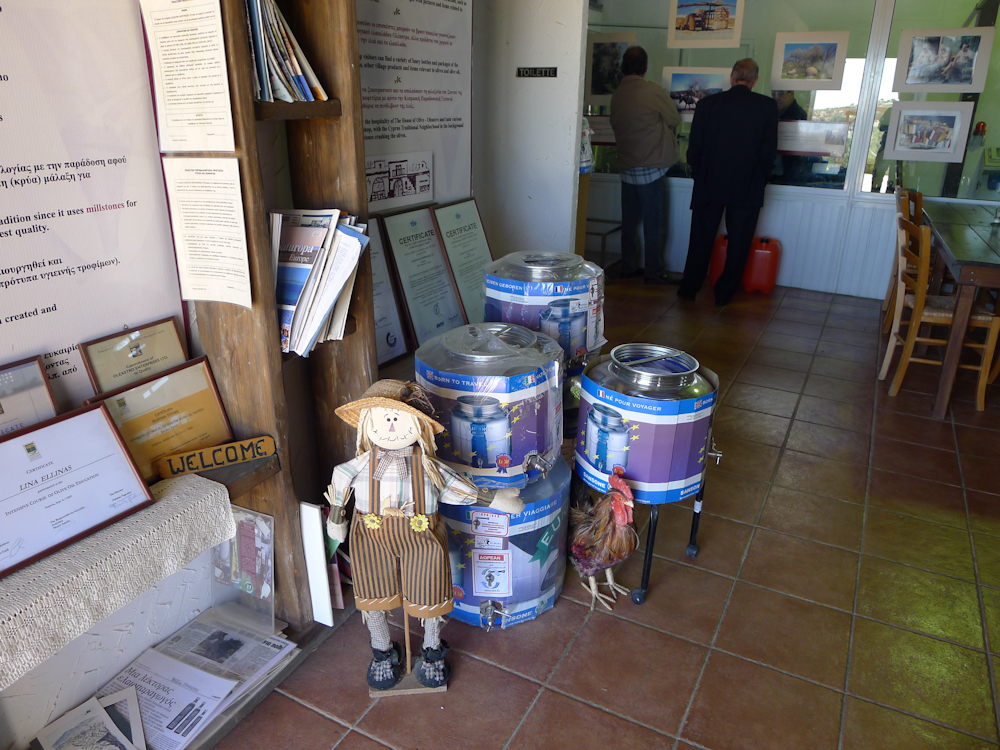
Anogira is the only press in Cyprus that uses millstones
to grind the olives.  They also have a museum and a
small cafe.

Andreas starts my olives' oil.

The two guys behind me in the queue.  The mill was quieter
this year than last -- maybe it's still early.

Monday, August 29, 2011

Nabbed by the National Guard


Well the Army found Alex on Friday.

Most lads get their papers at age sixteen, and since he had made it to seventeen and a half without their being served, we were wondering if somehow he had slipped through the cracks. Perhaps the host of irregularities attending his birth (mixed parentage, unwed parents, no number on his birth certificate, no baptism (previously only Orthodox boys served), parents moved district in early childhood) had led to his somehow evading the system – and since it is the obligation of the State to serve the papers than for the boys to volunteer, we thought that he might just be blessed with the choice of whether or not to don a uniform and pick up a rifle (there is no chance of non-combattant status in the Cyprus National Guard) when he finished school.

I had rather mixed feelings about this choice, and knew that should he face it, he would have to make it alone. On the one hand, I am a pacifist and hate the thought of my sons serving as conscripts in an army – as well as resenting the fact that the two years that the Army takes (and in many cases wastes with endless guard duty rather than taking the opportunity for serious training and creativity within either a military or a community service sphere) are two that would otherwise be spent in the enthusiasm of youth's creativity, curiosity, passion. On the other, I recognise the Army as almost a rite of passage for Cypriot men. If someone doesn't do it, everyone thinks 'Lucky Sod!', but they also realise that that individual has missed out on an experience that nearly everyone else endures – a bonding, for better or for worse... So I had resolved to stand well back and let him make his own choices within the embrace of parental support.

But a phone call from the police on Friday changed all that. The Army had been looking for Alex for weeks in Nicosia and had finally found him through a relative in the police with the same surname; he had to report to the 'Army Office' to sign his papers and provide reason for any possible deferrment within the next fifteen days, or he would be conscripted in January.

We went this morning to the government building, found the Army Office, and spoke to a corporal behind the desk. “Where do you go to school?” she enquired when he said that he had spoken to the police. When he told her, she sighed: “You pay all that money for a private school, and they don't get the papers right with us, ever!” He filled out his form, signed it, and she explained that we had to have a letter from the school by December saying that he was enrolled for this year – which corresponds to the Third year of Lyceum. Next year, when he will be finishing his A-Levels and school is not mandatory, he will need another letter and proof of fees paid.

“Typical!” Alex snorted when we got into the car. “You remember N, the kid who was like the unofficial student council, the liason last year when there was all the trouble (our school has undergone a series of upheavals in the last few years culminating in total shake-ups, take-downs, and seismic changes)? He was in a similar situation. Told the Army he was at my school, the Army called for verification, and the school said he wasn't a student. He couldn't finish his A-levels and he's doing his two years now...” I don't know what N's story was – except that he is indeed a gun-bunny these days rather than the A student that he was – but I suspect that his parents (like many at our school) had not paid this year's deposit because they wanted to see what all the changes would bring before committing to another year – and thus the school, with no reason to protect N, simply said that he was not enrolled.

We went to the school, and requested the verification of Alex's being a student, and the Director explained that he never filled out the Army forms. “I can't,” he said. “It's a violation of the state's privacy laws to give details of my students to anyone, even the government!”

That may be true, but at least he could have let parents know that the papers had been served so that they had the choice of whether or not to fill them out, avoiding a last-minute scramble! All of Alex's other friends from school have already either gone into the Army – being a year ahead, are foreigners who are exempt, or are girls.  

Tuesday, August 2, 2011

Crushing Shiraz


I used to dread the start of the wine-making year. Not involved in the actual grape-picking, I used to wait at home until Best Beloved arrived with the boxes of grapes and then sit and help de-stem and sort the grapes. I actively dislike no jobs in the house, garden, or field except this one. The sorting of the grapes into spoiled and usable, and the removal of stems, spiders, and bad fruit is tedious, slow, sticky. Hours hunched on a hard seat left my bum and back aching and my temper raw – how much worse for Best Beloved with his bad back, I could only guess, for he's not a whinger. The thought of this job has been hanging over me for the last few months, made worse by the fact that we have less help this year since the disappearance of Ha. Less help translates into more hours for me, I thought.

So I knew a shiver of delight last week when BB announced that he was heading for Limassol to buy 'a machine to help with the wine-making'. Foolish Asproulla! “No de-stemming this year?” I yelped with delight. Delight swiftly crushed. “A press for squashing,” came the answer. I assumed (what I hoped was) a winning expression: “But darling, we've fewer hands this year, and I dread the sorting-cleaning part of the job...” I tried to keep the hope alive in my eyes and the whine out of my voice “And we have more grapes than ever!”

So BB returned a few hours later with some new toys and a lighter chequebook, and this morning when we crushed the Shiraz, we got to play.

Because we have several different varieties of grape that BB blends for a unique taste and quality, we need to pick at different times. The Shiraz is ready first: higher in sugar than the Cabernet Sauvingan or the Grenache, and if it is left too long it will impart a caramel fruitiness that BB is trying to avoid. He tests daily for sugar content and pH from the moment that the grapes begin to truly ripen, and had decided that today was D-Day. Luckily this co-incided with the arrival of teenage cousins from Austria on their summer break, so BB and Cousin Philip headed to the vines just as dawn brightened the sky.


We had set up most of the aparatus yesterday: a scrubbed-out (by Leo with tremendous enthusiasm) plastic tank rested on Sophia's old desk, the stainless tank was cleaned and awaiting its crushed contents. The new de-stemming machine only needed to be lifted atop the tank, plugged in, filled – and all of the previous years' torture would be relegated to the realm of 'Remember when...' stories.

Alex and I were waiting for the grapes' arrival – only about 30 kilos came in four boxes. Stricter application of sulpher by BB meant that none were spoiled and manual sorting was unneccessary, so together we all lifted the new machine to its perch. Philip and Alex passed up the boxes, Best Beloved dumped in the berries and pressed the 'On' button. Paddles turned, wheels whirred, juice and skins dropped into the tank and stems shot out of the end of the hopper. In fifteen minutes the job was done and Leo washed his feet and climbed into the tank to do some final squashing. Even Sputnik enjoyed himself – he has a sweet tooth for fruit, and will carry around a single cherry or a piece of apple for hours – so he was in his element with stray grapes.


In previous years, hunched around boxes and bins, we would have gone through several relays of frappes, several fights between fractious little ones, several recitations of The Man From Snowy River, innumerable renditions of songs old and new, this year we finished inside an hour, despite a thorough cleaning of the machine... I suppose that you could have called our old way a 'bonding' experience (or 'bondage' depending on how you looked at it) but it would often be nearly lunch time before we had done the same job. Recovery would take the rest of the afternoon. I have no nostalgia for the past regarding this, and even find mayself looking forward to next week's crushing – we need to tweak the system a little so that the tank doesn't have to be emptied by bucket and ladle, but I'm sure we'll come up with something.


Monday, July 11, 2011

Gone To Soldiers, (Almost) Every One


When Cypriot males reach eighteen years, they are required to perform military service. Last year saw the first wave of the Big Ones' friends leaving for military service: Stelios went to the navy and did his training as a marine to guard one of the missile bases agaist seaborne attack (in theory, anyway), and Yiannis went off to the commandos – to do whatever commandos do.

Last week saw another wave of friends shaving their heads and going 'to the KEN' – as basic training is known by its acronym for The Centre of New Recruits' Training. Yioti also opted for the navy: he wants to retake his exams to get a higher mark and figures that between pulling guard shifts he can swot his physics and computer studies, Nick is probably heading for the infantry, Tzirkalis wants to be a driver, Dinos has chosen the navy... and Joey, whose ambition for the last three years of technical college has been to be a chef, is headed for the catering corps.

Alex still has two years before his enlistment starts: because he repeated a year of kindergarten (don't ask!), he is a year behind anyway, and because he is taking A Levels he has Grade 13 to complete instead of finishing at Grade 12. This means that most of his friends will have finished their service by the time he joins up, but he doesn't seem to fussed about that. He wants to join the commandos ('At least I'll stay fit, be kept busy, and learn something,' he said. 'Rather than being bored to death pulling endless guard duty or sitting up on some Godforsaken Observation Post on the Green Line!') and is hoping that his less-than-perfect eyesight doesn't disqualify him.

It seems such a short time ago that my friends and I were sipping coffee at a mother and toddler morning discussing army service and how we hoped that the Situation would have been resolved by the time our sons reached conscription age. Now for me, that's unlikely – with Alex, at least (maybe by the time Leo's eighteen, ten years from now, conscription will have ended) – and for my friends, impossible.

And where would the Cyprus National Guard be without the soldiers' mothers? There are no washing machines on the bases ('We washed everything by hand!' said Best Beloved, who did his service in the early '80s), so mums collect the laundry. The food is pretty bad: 'Mystery Meat stew,' said Stelios. 'You learned not to ask what was in it!' so mums bring home-cooked meals (hopefully Joey will change that for his fellow soldiers). Many conscripts don't yet have their driving licenses, let alone a car (and the stipend they receive will in no way stretch to a taxi), so mums living within ten miles of their sons' bases are constantly driving their offspring on and of post at odd hours.

Ah well, it's all part and parcel of living here. It will be our turn soon.

Wednesday, January 26, 2011

School Crisis

School is once again at crisis point. The Big Ones are at a private English language school, and have been for the last five years. In that five years we have seen the head teacher change four times and the premises change three. We have stuck with the school for two reasons: there is little choice, we were holding out for the move to the new campus – hoping against hope that all the promises we had heard would be fulfilled.


Each year the fees have gone up. September 2010 saw Secondary moved to a private afternoon college's building because the Department of Education revoked the license due to unsuitable facilities. We watched the new school a-building down the road with scepticism and trepidation – how could it possibly be ready in time?


It was ready – well, sort of. Classes started in the building site, but there were no electricity, no internet, no blinds on the windows, and none of the whiteboards, computer facilities, science equipment that we had been promised. Chemicals for the science labs were ordered two years ago... but they haven't been paid for yet, so students learn their chemistry and physics 'theoretically', without ever performing experiments.

The last days of summer saw the students sweating in glare-boxes, and winter finds them shivering now that the 'solar gain' of this, Cyprus' first ecologically designed 'green' school, fails. A directive has come down 'No hoodies or sweatshirts, scarves, or non-uniform jumpers.' ('But it's cold and the uniform's inadequate!' the children wail.) Oh, and there's still no electricity apart from the generator: something about the Electricity Authority saying that the school must pay for a sub-station, or the Church (who own the site) saying that the school needs to pay more. So the bargaining continues. And, no, there's no transparency, either.


When time came to choose courses for this year, Alex, in his second year of GCSEs managed a workable schedule, and seems happy enough with his course load of maths, sciences, and ICT. Sophia, beginning her GCSE's, was unable to take French, art, or Greek due to scheduling SNAFUs. We have to do those subjects out of school hours because she enjoys them and thus excels. She is less fond of biology and economics – classes that she had to take because of the aforementioned SNAFUs – not because she doesn't like the subjects, but because the teachers are way below par. All last year's biology students – who scored A's and B's on their mock exams – received D's and F's on the real thing: a reflection of poor teaching, and the cause of much angst and devastation among parents and students.


“I started the year determined to work even if the teachers were incompetent,” Sophia said during a tempestuous family discussion last week. “But I can't because I simply don't have time.” Her other extracurricular activities include Taekwando and swimming. “Even if I see the past papers, I am simply not getting the kind of feedback to know if I'm doing the right kind of work!”


Then, one of her two good teachers left just before Christmas. Despite being a department head, he was still on a temporary contract; his wife, also a teacher, was verbally abused by the head of the Primary School; and his children were refused a discounted education despite both their parents being teachers. No wonder he took the High Road and elected to join the ranks of the unemployed when his wife was offered a first class teaching package in the Gulf. His replacement, a young woman, cannot hold a candle to him.


So I am off to see the headmaster this week. I like him and feel sorry for him: he seems like a capable, competent, hardworking and genuine man, but I think that he is being messed around by the directors and will probably not last even the two years that his predecessor managed. I'm going to complain – not because I believe that it will do any good, but because more voices of dissent need to be heard. Those of us who have stuck with the school are really fed up.


In the meantime, Sophia is investigating boarding schools in Britain, and salivating at what she sees. She cannot change for September 2011, but can apply for 2012 when the GCSE course is over. I had my doubts when she broached the subject of leaving, but when we discussed it in depth, I realised that her conclusions mirrored my own when I was fifteen and knew that I would have to leave Hawaii or sink academically, emotionally, and socially. I wound up at Madeira, and never regretted my decision.

Monday, October 18, 2010

Earthworks


Well the diggers have moved out after a week’s tearing, grinding, chipping, and placing of rocks, and I am left with a whole new canvas on which to work magic… or totally screw up.


As my long-suffering readers know, I am on this new kick of rainwater harvesting. Cyprus is not short of water – if it’s collected and used prudently. But there is no infrastructure outside the big dams for rainwater harvesting, and when the rain does fall here (sometimes torrentially between November and April), much of it just slides off the saturated land, tearing off topsoil and staining the sea for hundreds of metres. If that water were captured and either stored in the land in the form of passive earthworks or stored in tanks like it is in Australia, problems of erosion and increasing desertification would be slowed down, there could be a lessening of summer water rationing, and costly oil-driven desalination plants might not need to be rushed into production.

But all that’s wishful thinking on a national scale. All I can do is work on my own little patch.

As I mentioned in an earlier post, I have been constructing berms and basins -- a la Brad Lancaster’s suggestions in his excellent book Rainwater Harvesting for Drylands and Beyond – around the trees in the field. I have been trying to do two trees a day, but a week’s cold held me up so I am 14 trees behind schedule and still have around another forty to do. Each tree needs to have the soil and organic matter – leaf drop, old compost, straw – cleared from trunk to drip-line, then a berm about a foot high constructed on contour at drip-line to catch the run off from irrigation and rain and hold the moisture to let it slowly infiltrate the soil. After I have cleared the soil around the tree, I put a layer of cardboard to help keep down the tenacious, pernicious, and down-right ornery, hard to eradicate rhizome grasses that grow wherever there is moisture, then I add a layer of compost and straw to hold the moisture when it arrives. Look at the calendar: we’re nearly at November and rain has threatened a few times. I am trying to get as much done as possible before I have to deal with mud and run off and all such work grinds to a halt.

(Left)I did this apple tree this morning: in the background weed-infested apples await tomorrow's attentions.
(Below) Necatrine trees. The upslope side is open to catch run-off, and mulched only with a layer of straw. The downslope side is bermed and heavily mulched with cardboard to deter weeds, then covered with a layer of straw.


But the diggers weren’t working in the field. Oh no! They were following a long-laid plan nearer the house to terrace the slope below the olive grove/kitchen garden, where previously a haphazard line of boulders had delineated the beginning of the long drop to the gorge. Then they carved out another terrace on the edge of the property where a road/fire-break – its outside edge to be planted with prickly-pear cactus as another precaution against fire – will circle the house below the retaining wall, giving us almost 360 degree vehicle access to the house.

(Left). Before


(Left) After.


Then Best Beloved decided on a line of Cypress trees above the road – Tuscany comes to Paphos – under-planted with rosemary, lavender, and dryland ground cover (all also bermed and basined and mulched to catch rainwater and divert run-off from the driveway). I finished that this morning, having enjoyed Leo’s invaluable assistance all weekend.


The trouble is that while the diggers did the big earth cutting and rock moving, they left me with the smaller ones. Alex and I have started building dry-stone terraces, again following Mr Lancaster’s instructions. Thank goodness for strapping teenage sons! Alex has willingly schlepped rocks and cut balks to my instruction. If these terraces succeed, thanks will be largely due to him. If they fail, the responsibility is mine – but I will have climbed many steps up the learning curve.

Tuesday, August 3, 2010

The Larks, Still Bravely Singing, Fly

Our bikes – big sturdy 21-speed touring machines complete with carry tray and bungee on the back, lights, and padlocks -- cost 10 Euros each per day and we arranged to have them until 7 p.m the next day. We wobbled off (I hadn’t been on a bike for25 years and the others, although more familiar with two-wheeled transport, were unused to riding in traffic on the wrong side of the road) following the route marked on our maps and signposted by red hexagons every couple of hundred metres.

We did the southern part of the route that first afternoon, the hexagons leading us past several cemeteries and the memorial at Hill 60 to the main road between Menin and Ypres (I’m using the old spellings here – since this area of Belgium is Flemish speaking, the French names have been replaced, but as we were here on a battlefields’ tour, I will use the more familiar spelling from days gone by). We stopped and wandered among the graves, reading the names and the ages, feeling the deep peace that settles on such places, enjoying the flowers.


Padlocking our bikes we wandered among the shell holes that still pit Hill 60, tripping over iron embedded in the earth and skirting the brambles that climb over a collapsed dug out before reaching a main road that led back to Ypres. Realising that we had missed the museum and trench systems of Hill 62, we decided to cut the day short and go back to Ypres for a meal and a rest, catch the train back to Poperinge, then make an early start the following day and ride the rest of the route.


Arriving at the station, we found the train delayed by more than half an hour.


‘You can leave your bikes in the lock up over night or take them for 5 Euros each,’ the station master told us. ‘But why not just ride back? It’s only 12 kilometres and you’ll probably beat the train.’


We did that, but unlike all the other roads we had been on, the Route Nacional to Poperinge was not bike friendly. Halfway there we passed a sign saying that bikes were not permitted on the hard shoulder, and twenty-ton international lorries hurtled beside us. I cycled behind Alex and Sophia wondering what I would tell their father if I lost them to traffic. As we pulled in to Talbot House, Sophia turned to me: ‘Just so you know,’ she said. ‘I’m not riding into Ypres tomorrow morning!’


The next day we were all feeling tender. Muscles long unused protested, seat bones felt bruised. We took the train back to Ypres and set out for Hill 62.


On the way, Sophia decided to get to know the cows. ‘We don’t have cows in Cyprus,’ she said, dismounting her bike and approaching a small herd, camera in hand. We do, of course, but not cows like these. Cyprus cows are kept inside, and rarely seen. They’re smaller than the great Friesians and Charolais who approach eagerly, lowing and licking their noses with great rasping tongues. Sophia was entranced, but I could not let her linger. We had miles to go and had to have the bikes back by seven.


Hill 62 has a partially restored trench system and a chaotic museum, but was well worth visiting. I wish that we had brought torches, and were wearing sturdier shoes as many of the dug-outs are still standing and safe to enter, although dark and muddy. From there we cycled back to the main road, up to the memorial at Polygon Wood and into the village of Zonnebeke.


…Where we got lost. Somehow, either the map was wrong or we took a wrong turn, but we ended up many kilometres out of our way, hot, hungry, and out of sorts. No restaurants. No pubs, even to get a sandwich. I beckoned to the only person on the street to ask directions, and as he swayed blearily toward us, Alex muttered sotto voce ‘You had to find the village drunk, didn’t you mum?’ Well the village drunk couldn’t speak much English, but he waved over a passing ambulance whose smiling driver put us right and about half an hour later we arrived at the Commonwealth War Graves cemetery at Tyne Cot, just outside Passchendaele village.


Tyne Cot is the biggest Commonwealth cemetery in the world. It includes 11,954 burials, of which 8,367 are unnamed and its Memorial to the Missing is an continuation of the lists on the Menin Gate and contains the names of 33,783 soldiers of the UK forces, plus a further 1,176 New Zealanders. Our visit coincided with those of several coach loads of British school children who passed among the rows of headstones taking notes, making rubbings, and occasionally calling to each other.


‘I cannot believe,’ said Sophia, looking around. ‘That so many men died over such a short space of time, for that tiny rise of ground. What did it mean? What does it ever mean? Did they think it was worth it?’


We spent about an hour there, resting in the shade by the New Zealand panels naming Missing, and discussing some of the themes that had occurred. ‘Do these memorials create a cult of heroism and glorify war?’ I asked the kids, playing Devil's Advocate to make them consider the possibility. And ‘What about the men who refused to go? Who endured prison, or were killed because they refused to go to a war in which they didn’t believe?’


‘We never talked about Conscientious Objectors in class,’ they said. ‘Dissent was not a topic. Who decides the curriculum anyway?’ That question led to the notion of a standardised curriculum, and the pitfalls that teachers encounter when they are forced to tailor class discussions to the passing of standardised exams. ‘But these things are important!’ They agreed. ‘Does somebody not want us to know that dissent happened? That people were punished, ostracised, imprisoned, shot – for following their beliefs? That going along with the crowd is not necessary?’ For me, these conversations were fascinating. I couldn’t provide many answers, but I was glad that the questions were being asked.


To Be Continued

Wednesday, May 5, 2010

Medical Morning

Alex and I had a medical morning.

Last night, while sparring in Tae Kwon Do, he kicked someone who used his elbow to block. Elbow connected with instep, and Alex was worried that he had broken a bone in his foot.

Although I knew that there is not much that can be done for him – he was walking, albeit painfully, and he said that some movements made him feel sick – I said that I would take him to the nearest private hospital, Iasis, for an x-ray after dropping Sophia at school. I didn’t want to face the bureaucracy of the General without Best Beloved to smooth the way.

So at 7.30 this morning, we rocked up to Casualty under the sign ’24 Hours’. Casualty was empty. We went around to reception and I explained our mission. “Oh, you’ll have to wait half an hour or forty-five minutes”, said the receptionist. “Staff aren’t here yet.” Alex and I discussed waiting or checking somewhere else, and the receptionist helpfully said: “And we’re closed between noon and four!”

“What,” I asked her “happens if someone needs an emergency x-ray at lunchtime?” She didn’t understand.

I called Evangelismos (another private clinic), but their radiography department wasn’t open until eight, either. We opted for the General Hospital, and I checked my wallet to make sure I had the ‘Poly Techni’ card, the card that says that as a family of at least four children we are entitled to free state medical care. Only problem was we are not pre-registered at the hospital for any care, and previous experiences of the State medical system did not bode well.

“Prepare for a Cultural Experience!” I told my son.

“Beats school,” was his answer.

We drove to the General, but could we find parking? One would think that in designing a new hospital for a mushrooming town fifteen years ago, the architects would have made enough parking spaces, but no. We parked on the street 300 metres from A&E. Once in the door into the empty department, I said to the nurse under a sign marked ‘Triage’: “ I need an x-ray for my son; he thinks he’s broken his foot.”

“This boy?” she said. “The one who’s walking?” But we filled out the forms, showed our poly techni card, and almost immediately were seen by a doctor who poked the lump on the side of Alex’s instep, grunted, and motioned down the hall to the x-ray department.

More forms. “Can you tell us how long we’ll be waiting?” I asked the receptionist. “Not long,” she assured me. “There’s just one ahead of you and then they’ll call you.”

We sat on the slatted wooden benches and looked around the crowd.

Most of the patients were older people from the villages. Neatly dressed, well groomed, and bearing themselves well. None looked ill; there were no emergencies here, just routine visits requiring endless waiting on the hard chairs, a gossip with neighbours and friends from previous visits. There was some good-natured grumbling about how ‘we could die in here in turn waiting to be seen’, but by and large people waited quietly. An electronic counter on the wall proclaimed ‘Your turn’ but the number space below was blank. A hand-lettered sign on the wall notified us that if we missed our turn for any reason, we would have to reregister. People kept coming in, going to the desk, signing in, sitting down. The room grew stuffy.

Lise’s mother-in-law arrived for her weekly check-up, immaculate in her widow’s black, gold cross on her chest, each grey curl in place. She recognised me and we chatted for a while but I found her rapid Paphos dialect too fast to follow properly and she smiled and turned to the man at her side who was from the same village – but not before inviting me, with the infinite hospitality of the Cypriot villager “To come some time with Lise and drink coffee with me at my house.” I assured her that some day I would.

After an hour Alex went to the desk. “Can you tell me how long I’ll be waiting, because I’m missing school?” The woman shrugged. “God knows.”

An elderly woman emerged from the corridor leaning on a stick. “I was the first,” she announced. “They’ve only just started on the queue down there.”

“Mum, let’s go,” he said. “You won’t be charged because although we’ve signed in, I haven’t had a procedure, and this is just a waste of time!” I looked around at the handsome, patient faces in the waiting room and had to agree with him. We weren’t retired with nothing else to fill the day, but I hated to leave the foot unattended.

As we walked across the parking lot, Alex winced again. “Maybe we’d better go to Evangelismos,” he said. “They’d be open now, and where the doctor poked me, my foot really hurts.”

A young man in blue scrubs was behind the desk at Evangelismos A&E. He took Alex’s details and an elderly doctor made a quick exam. “Might be broken,” he said. “X-Ray’s down the hall.”

We didn’t wait at all. The Bulgarian technician took Alex straight in and, spotting Alex’s uniform quizzed us while we were waiting for the pictures about Alex’s school. We had to wait a while for the radiographer to confirm no fracture, but chatted with the receptionist – who turned out to be a paramedic friend of SH who taught my Emergency Care course last year, and also the man who took such good care of my friend Angela when she had a mini-stroke last year. Angela had sung his praises to me several times: how patient he was with her, and how reassuring. I was glad to be able to pass on her thoughts.

I dreaded the bill. Private hospitals have a reputation for charging the proverbial arm and leg, but the doctor waived his fee, and when he heard that we have only in-patient insurance, the receptionist charged us only for the x-ray and the bandaging. We paid only 44 Euros – less even for when SH brought me in in the ambulance during the course for a dicky heart after a hornet sting.

Alex tried to weasel out of returning to school but I wouldn’t let him. I did let myself off the gym, and three and a half hours after I’d left the house, walked in the door to face the breakfast dishes.

Monday, December 21, 2009

School Christmas Party


Friday was the Big Ones’ school Christmas Dance. Like last year it was held in the Aliathon Hotel, tickets 25 Euro a shot, 7.30 to 11.30, buffet dinner and DJ. The few days leading up included a flurry of shopping. “I’ve got to have shoes, Mama!” “I need black jeans that fit and a red tie!” “How do I clean my skate shoes?” (Answer: “You don’t – ya gotta buy a new pair of shoes..”)

Fortunately, Sophia fits into my clothes and had no wish to buy anything new as I had found her dress several months ago.

Thirteen and a half years ago, when she was just a baby, we went out to Hawaii to visit my father. Strolling through the Ala Moana centre one day, infant in arms and toddler in tow, Best Beloved and I stopped in front of a dress shop.

“That would look lovely on you, Manamou!” he said, pointing to a reddish, slinky number on a manneqin. “Go and try it on.” I did, and it hung awkwardly, but when I tried on the smaller one, despite hugging my various bulges, it looked better.

“I’ll be losing those soon, anyway,” I said to myself. “I’ll get the small.”

The price tag of $369 made me wince a little – this was over a decade ago, and that seemed a lot to me for a dress – but I bought it…

…And never wore it. Never even removed the tags. About 4 years ago I tried it again, realised that I had grown even more bulges that I would never lose, and took it to the Dogs and Cats charity shop.

Last summer, flicking through the dress racks in the Cancer Patients’ charity shop, a familiar reddish tinge caught my eye. There was my dress – with the tags from Ala Moana still attached.

I bought it for a Euro and it fit Sophia perfectly.

Wednesday, December 16, 2009

My Children Sing in the Car.

Probably everybody’s do – and I know that when my siblings and I were young, we used to sing often – in the car and anywhere else, heedless of wrong notes, mistaken words, and variable keys. But hearing Zenon and Leo sing song after song – in Greek and English – during a twenty-minute car journey is one of my almost daily blessings.

And I don’t ask them to. One will start, and the other will join in – their voices generally true, even for children of nine and seven. Usually they sing songs learned at school – traditional Greek or Cypriot ballads or patriotic songs. Occasionally they sing pop songs, and Zenon has acquired a taste for soft rock, so that between glorifying the heroes and martyrs of 1821, he will launch into ‘Desperado’ – often with very strange words as he hasn’t managed to figure out what the lyrics are and just adds his own approximation.

He also has a liking for ‘Eye of the Tiger’, but fortunately his rendition only occasionally figures in the repertoire. Lately he and Leo have learned the words to ‘Jolene’ thanks to someone’s leaving a CD in my car. Both Zenon and Leo have picked up not only the lyrics, but Dolly’s accent, too. The other day Best Beloved pulled out of the drive on the way to town, and drifting back down the drive came ‘Ah had t’have this toke with you, mah happiness depends on you…’ A day or two later, apropos of nothing, Zenon suddenly said “What’s a toke, Mama?”

Alex has a true voice as well, and will often sing with me: our repertoire ranges from Kathy Mattea’s ‘Eighteen Wheels and a Dozen Roses’ to Meat Loaf’s ‘Bat out of Hell’ complete with motorcycle sound effects. He has an instinctive ear for harmony, so we do quite well together.

Sophia is more inclined to join Celine Dion or the Dixie Chicks when she’s listening to them on her computer. Unfortunately it’s hard to persuade her that her singing with headphones on means that we get a tuneless drone – she just shrugs when we stand in front of her pointing at the headphones and wincing.

She is the one who most wants to be able to sing well, as she has hopes for the stage. But people ‘in the know’ have told her that an ability to sing and dance gives one a better chance of acceptance into acting school, and a good drama school is practically pre-requisite for a stage career. She has started learning to play the guitar, and I have been trying to explain basic theory. But “I don’t want lessons!” she insists. “That’s the quickest way possible to put me off music.” Unfortunately my knowledge is very limited, and if she applies herself as I know that she can, she may be looking for lessons within the next year or so as she realises that self-teaching can take her only so far.

Now that Christmas is around the corner, we are regaled by a range of carols. Rudolf (in both English and Greek) is reindeer non grata, and I’ve threatened to put a boot through the Little Drummer Boy’s instrument if I hear of it again (never liked that carol!), but the house and the car are full of ‘Jingle Bells’ – often including the parody ‘Batman smells’), Silent Night, and Greek and Cypriot seasonal songs.

It’s good to be surrounded by music.

Monday, June 22, 2009

Summer Picnic

“Wow!” said Sophia. “Real water that's not in a bottle or the tap! Or,” as an afterthought. “The sea, of course...”

We had reached the river.

Wondering what to do on a long Sunday morning, I had suggested a pic-nic and we agreed that we should visit the Turkish Cypriot property that we rent in the village of Agios Ioannis. Then Best Beloved developed the theme further by saying that on the way he wanted to visit one of the Ottoman pointed bridges near the deserted monastery of Synti, so we packed an Eskie and some plastic plates, bought some water, ice, and fruit at the kiosk in Mandria, and headed into the hills.

I was in a spiky mood. Since having children my sense of physical adventure has largely deserted me, and while 16 years ago, heading off into the hills for some off-road adventure in a Land Rover would have been grist to my mill – I used to drive diving safaris in the Sinai, for god's sake! – these days I am more inclined to adventure of the armchair variety. Armchairs don't tip over, get flat tyres, run out of water, or crash. “Oh for heaven's sake, calm down and relax!” exclaimed Best Beloved in frustration when I begged that he ask for directions in the kiosk. “We speak the lingo and we're never going to be far from a village!”

I calmed down and relaxed somewhat as we reached Nata and asked about the bridge. “Go down to the river,” a local told us. “You'll find an asphalt road marked Kelokedara...” Where the asphalt road crossed the river we asked a man filling 20 litre jerries how far the bridge was. “Follow the sign to the monastery, then keep going. It's a long way, but there's only one road!”

The asphalt petered out to dirt and stones. The river appeared and disappeared, sometimes flowing underground on its way to the dam, and as we pushed further into the hills, big rocks and trees began appearing along its banks. We reached the restored monastery of Synti, and although it was locked, the children and I wriggled in through a window and explored various nooks and crannies. Then we pushed on to where tall trees and oleander bushes overhung the water, and the coolness and ample shade invited us to stop for lunch. Only one other time have I ever seen a river running during the summer in Cyprus – the same for Sophia, hence her comment.


After lunch we paddled, and where the creek ran shallow and narrow I suggested building a dam from some of the big, smooth rocks that formed the bed and banks.

Sophia was the first to start, laying four or five flat stones as a foundation from the far shore. Whether from bravado, lack of thought, or a random urge to destroy, Alex dropped a boulder on the lot – wiping out her work, and splashing all of us. Furious, Sophia turned on him, and Best Beloved, too, told him off. Construction resumed, with the Littles and me working on one side, and the Big Ones on the other.


Alex picked up another big boulder, sighted it precisely, and let it drop into a hole. The resulting splash wet Sophia again, and she turned on Alex and attacked him, throwing the rock that was in her hand and lunging at him.

Alex holds a Second Dan black belt in Tae Kwan Do; Sophia will take her black belt exams next year. They both have tempers, and are both suffering the hormonal tides of adolescece, so life with them right now can be... exciting; and the occasional physical conflict is like Clash of the Titans. The fight lasted about a minute, with more boulder hurling, a choke hold or two, and some effective kicks and punches before Sophia scrambled to her feet, grabbed her handbag and stormed off, unhurt but angry with Best Beloved's admonishment to not 'go far because we're leaving soon' in her ears.

We chastised Alex for not keeping his temper, and for – yet again – overreacting to provocation, and returned to dam building, imagining Sophia just out of earshot beside a shady pool with her book.

Half an hour later, we decided to pack up. No Sophia. Anywhere. After five minutes of searching on foot along the river, we got in the Land Rover and drove a little way in the direction that she had walked. Calling, sounding the horn, searching, produced nothing. Alex spotted a shepherd a top a steep hill, and climbed up to him to ask if he had seen her. Nope. We sent Alex back to the picnic spot with my phone and told him to wait there – family rules being that if someone is lost or separated they return to the place where we were last all together – while Best Beloved and I drove back along the river with the Little Ones.

Three quarters of the way to the monastery, we decided that she couldn't have come this far: it was midday, the temperature in the mid-thirties, she had no bottled water, and Sophia likes her comforts. After an hour's searching I was worried that she was either snake-bit or hurt. Thank goodness we don't have to worry about abduction here... yet. But “I didn't like the look of that shepherd!” Alex muttered. “And he was a Syrian!”

“Alex, he's hardly going to leave his sheep, dash down the mountain, hurt or abduct Sophia, and dash back up to his sheep again,” I said. “And besides, my experience of Syrian shepherds is that they all look dodgy, but the ones I've met have hearts of gold...” But that still didn't get us Sophia.

“Drive all the way to the monastery,” Best Beloved finally told me. “And if she's not there, call me. I'll go back along the river.” Alex and I got into the Land Rover with the Little Ones knowing that we were one step away from calling in reinforcements. The nearest police station was Kelokedara, and it would take at least an hour to get a search team assembled there, and another hour before they could be out in the bush. We had plenty of light left, but the afternoon had gone from being one of light-hearted adventure to one tinged with menace.

Where Best Beloved and I had turned back before, Alex and I saw Sophia sashaying along the track in the direction of our picnic spot. I pulled up beside her, feeling grim as she gave me a saccharine smile. “I really hope that you've been enjoying yourself!” I said as she climbed into the back.

We called Best Beloved to say that we'd found Sophia, then backtracked to pick him up. “Did you not think that we'd be looking for you?” he asked her “That we'd be worried?”

“Oh, yes. I knew you'd be looking for me!” was her cool reply (“I'm suffering, and I'm going to make all of you suffer, too...”).

We didn't say anything all the way back. When we reached the house, the Big Ones went their separate ways – although I called them back to help wash the picnic debris. Zenon took the dog out for a walk, and Best Beloved and I discussed the afternoon. “I'll talk to her in a bit,” he said. “There's no point in punishment – this is teenage attention-seeking – but she's got to realise that it doesn't work like it's intended.” We agreed that while the roots lie in her age, her best friend's death last month probably contributed, and Alex's breaking of her phone last week was a more recent catalyst.

“How does the poem go?” Best Beloved asked. “'Ours is not to reason why/Ours is but to do and die'? And not give up on them. They will make us suffer – I never got to see my bridge – and we have to be patient and strong and guide them... And everything will turn out all right in the end...”

“If I'm not in the loony-bin first,” I finished for him. Before promising that next weekend, we'll try again – and this time, we'll find his bridge.

Tuesday, February 10, 2009

February Weather

For the last four days, we have seen little sunshine. Saturday was hazy. Sunday, dark and brooding. “Please put the tractoui – the rotivater – through the vegetable patch,” I urged Best Beloved. “I really hope that it will rain, but if it does, I can do no work for at least a week and if the earth isn't turned we'll lose a lot of time on the spring crops.”

On Sunday morning he did the vegetable patch, and we finished pruning the vines and the trees in the field. Then he put the tractor through the field, as well, turning under the newly sprouted weeds that had given the lanes between the trees a soft dusting of green. He did the olive grove, too, and we started pruning the long suckers that have grown from the trunks and branches that we cut back so radically last year.


Usually we start pruning at this time. This year, because of the unseasonably warm winter, we are struggling to finish before the trees blossom, and as I cut the apple branches, sap bled from them. Some of them had started blossoming already – although they are usually a week or two behind the peaches and nectarines which have yet to break into bud. “The weather's going bananas this year, Manamou!” Best Beloved called from his seat on the tractor.


I cut some apple branches to take into the house so that we can have blossom on the table. The almonds are already out, a pink and white veil floating over the hillsides.


On Sunday night, the wind woke me as it screamed around the house. In the morning, it was still blowing – from the east – heavy with dust, and warm. A grey haze covered everything.


The wind blew throughout Monday. In the Middle East, this wind is called the khamsin, and is said to drive people crazy. When I lived in Israel I heard that a man can be forgiven the murder of his wife after seven days of khamsin (but could a woman be forgiven the murder of her husband? I wondered.)


Last night the wind backed and became chilly. I had just snuggled into my down duvet, slightly muzzy from a glass of wine, when it hurled handfuls of huge water drops against the side of the house, and one of the french doors upstairs slammed. A white flash lit the sky, followed at once by an infernal crack of thunder


I pulled on my dressing gown. The hall light snapped on as Alex threw open his door to see what was happening and if I needed help. We raced up to the sitting room and wrestled the blowing door shut, then I opened the front door to check the car windows. Within seconds, my hair was plastered to my head.


Throughout the night the storm woke me intermittently, but I snuggled deeper into the down quilt. I knew that today there would be no work in the field. There will be no work in the field for at least a week: I am free to plan, to order seeds. To buy another fifty metres of twenty-millimetre hose and six sprinklers for the new lines that I will put in when the earth becomes workable again.


In a lull between showers this morning I went out to the back verandah and looked toward the mountains. The air had an edge, the brittle bite of snow. Chains will be needed above Platres for the next week.


The rain is still falling. On our fields and above them. In the hills, into the dam. We need more, much more to see us through the summer without water rationing. But for now this is what we have, and we are grateful.

Sunday, February 1, 2009

Birthday Feast

Well I can unequivocally say that I don't like eating crocodile. Been there, done that. I only tasted a little, so I don't qualify for the t-shirt. But let's just say that if I see croc on the menu when I'm anything short of starving, I'll pass.


Alex turned fifteen last Monday. He didn't want a party, but hankered for 'something special' so when I mentioned that I had seen exotic meats – including crocodile tail – on the board at Butcher Boy, his eyes lit up. “We could invite Papoose and YiaYia (Grandpa and Grandma) and not tell them what we're eating...”


In the end we decided on a menu of crocodile tail, kangaroo fillet, and wild boar, and I settled down in front of the computer to decide how to cook them. “Roast the hell out of it,” suggested the man at Butcher Boy. “A crocodile tail does a lot of lashing about, so it's going to be stringy and will need a lot of cooking.” But everything on the internet contradicted him, with many a caution 'not to overcook'. The kangaroo was easy: “Treat it like steak....” (“On the barbecue!” said Best Beloved. “With the wild boar.”) At the last moment the lovely Romanian woman in the frozen shop gave me two wood pigeons “For your son's birthday present!” and the instructions of how to cook them: “Cut them in half, fry them, add maybe a cup of stock and a splash or two of white wine, then cover and simmer until they're soft. When they're ready and the liquid is all reduced, add a dash of Worcester Sauce.”


The Grand Folks (informed as to the menu) were invited for seven last night. Alex decided on pan fried crocodile tail with spicy dark sauce and lime risotto. Best Beloved fired up the barbecue, and I started on the salad. Then came a phone call from Sophia who had been spending the afternoon with friends in town: “The bus just drove right past me...” I handed the knife to Best Beloved and ran for the car. Forty minutes later I returned in time to start the risotto and pigeons, to find the table set, the kitchen and sitting room tidy, and Skippy about to go on the grill.


I made the sauce. I braised the pigeons. I stirred the risotto. I put butter in the pan for the croc, let it foam, and added the round, whitish steaks. They looked all right. They smelled a little strange. I cooked them like I would a tuna steak, and everyone gathered around sniffing with strange expressions. “Yucks!” said Zenon. But he says that to everything.


We served it as a starter with a spoonful of risotto and a dribble of dark spicy sauce per plate. “Let Alex try it first!” said Best Beloved. And Alex took a bite. “Not bad,” he said, taking another. Everyone except Zenon tucked in – and all, except me, had the grace to finish.


It tasted like fishy chicken. Or chicken-y fish. No, not my style at all. Even though I liked the sauce – rum, garlic, ginger, chilli, and sugar. And the risotto was wonderful.

My dislike for the croc wasn't based on squeamishness. I would eat snake if it were offered, and guinea pig – though I think I would draw the line at insects. I've eaten frogs and snails, hearts, tripe, haggis, and tongue. I don't like liver, kidney, and brains (my mother forced them on me when I was little, but I hated the taste as a child and still do.) Croc tail just didn't taste nice – and I have the feeling that I wouldn't like it barbecued, stewed, broiled, or any other way.


Then Best Beloved brought out the 'roo and the wild boar. They disappeared in a flash along with the pigeons which (everyone coo-ed)were delicious. But I didn't care for Skippy or Wilbur. Too gamy. And I've never liked pigeon. So I ate a lot of risotto and a fair bit of salad – and of course demolished my share of the cake.


In the morning I put the last piece of fried croc into Stumpy's bowl. He sniffed it. Looked at me. Sniffed it again. Then twitching his tail, he hobbled off. I guess he doesn't get a t-shirt, either.

Tuesday, January 27, 2009

Alex's Birth Day

WARNING: The following includes a birth story. It's not gross or graphic – it's just a birth story. But some people might not want to read it.

Yesterday was Alex's 15th birthday. Taller than me now, he has feet bigger than his father. But I can still see the baby behind the almost man. And I can still remember his arrival.


I knew nothing about babies. I hadn't even really thought of going to the doctor before Best Beloved suggested it. “Why? I'm not ill...” I had said. “It just might be a good idea” he gently persisted. “Most pregnant women have check-ups.”


I chose a female doctor, reasoning that women understand women better than men do. She had trained in Germany, spoke English with clipped Teutonic tones, and frequently used the word 'Kontrol' when she meant 'Check'. Best Beloved had his doubts. “She seems a little Authoritarian” he said. “But it is your choice.”


I didn't understand what the Big Deal was. Women had been having babies for millenia, hadn't they? The private hospital in Nicosia where Alex was born offered ante-natal classes, and I went to two. They were taught by a woman who had never given birth and who made the whole event seem no more than a mild inconvenience. “When the baybee eez about to be borrn, you may feel a need to poosh,” she said, smiling. “But no eez goood to poosh naow. You muzt wait for when the doctor say you, or maybe you'll have a torn.”


Alex was 'late'. Five days late. “You musst come effery day for Kontrol!” said Doctor I. “Zis musst not go on for too long.” Lamb to the slaughter, I nodded meekly. She was the pro: she must know best. “My husband can be there, can't he?” I asked. She huffed. “Ass long as he doess not get in ze vay!” Finally she said. “Vee must induce!” and before I could ask what that meant, shoved a pessary up me. “Just vait!”


We didn't 'vait' long. An hour or two later I was screeching for pain relief. “Why didn't anyone tell me it would be like this?” I was given Pethedine, but like half the women who have Pethedine, felt little noticable pain relief – just a lot less control. I couldn't walk anymore and had to lie on my back.


The midwife was a Battle Axe. “You don't spik Grik! Huff!” so to be obliging (if-I-make-friends-with-this-woman-maybe-she-will-make-the-pain-go-away) I gasped out “Arhizei!” (“It's starting”) every time a contraction began and “Telionei!” (“It's over!”) every time it finished. Sometimes she had the grace to say “Bravo!”


Finally Dr I came into the room and peered between my legs. “OK, take her in!” she said and I was wheeled into the bright lights of the Delivery Suite (makes it almost sound comfortable, doesn't it?), Best Beloved at my side, seething, though I didn't know it. Then it was feet in stirrups and the snapping of latex gloves followed by the most powerful compulsion to push that I have ever experienced. Terrified does not describe what I felt. No word articulates that fear. Fear is not the word. Fear and pain paralysed me. I was going to 'have a torn'. I was being split in two... And then Doctor I said “No, you must not push now!” How could I not? I was in the grip of something incalculable, unbearable, beyond anything that I had ever experienced or dreamed of. My eyes sought Best Beloved's. At least he was still there. His grip became my lifeline.


I heard the metallic clink of instruments, then, unbelievably a whitehot slice as she cut me open “So zat ze baby vill haff more room to come out... See he had ze cord around his neck...” Everything suddenly happened very fast, but all I felt was a slithery thing between my legs and the unbearable scissor-cut. Then Doctor I wrapped the cord around her right hand, braced the other against something and began to pull the placenta out. "Ha! Yess. Ve haff it all here!"


Something blue was carried over to the sink. I heard a thin wail. Was that mine? Doctor I started prodding around her scissor-slash and I felt the stab of a needle. I screeched – far louder than the blue thing in the sink. “Now, keep still. I must sew you up but zis vill not hurt!” But it did and I asked for anaesthetic. She huffed again. Jabbed in a needle. Waited half a minute and began to sew again. A stitch later and I screeched again. “I cannot give you more anaesthetic!” she said, and sewed on regardless. Eight stitches.


Someone brought me the blue thing. He was wrapped in a white blanket and looked up at me through milky eyes from an elongated face. No hair. No brows.


“Now what do I do?” I thought.


I began to get to know him over the next few days in the clinic. He stayed in the nursery: the only child there. I could hear him crying between the times that the nurses brought him to me for feeds, but was told that going to him would spoil him. I was shocked and shaky and dizzy when I stood up.


After three days, I took him home. But I couldn't keep to the schedule of a breast-feed every four hours and chamomile tea between. I became nervy and sad, snapping at Best Beloved and insisting that he take the baby away when he cried as I couldn't bear to hear him and had been told not to nurse him. After a week I asked my GP, a Scots woman with a sensible attitude to everything. “Och don't be listenin' to that crowd! When he cries, pick him up and stick a tit in his mouth. Give him a cuddle, sit there and relax with him... Fancy that! Telling a new mother with her first bairn to leave him alone when he cries and just give him chamomile tea...”


When I followed her advice, life became less stressful. Breastfeeding was not common here then – without Dr Cecilia I would have given up. No one told me how to do it and the hospital suggested formula when I said that it hurt. Because nursing is not done by my generation in Cyprus, I had no idea if it was acceptable, and Best Beloved said “Just do it anyway!” so I did. The reaction surprised me. Cypriots of all ages were supportive. Old men and women smiled, several coming up to confide “I wish that my daughter had nursed. It's so much better for the baby...” “My daughter in law tried, but couldn't do it and the hospital said that bottles were easier and that she would lose her figure...” Younger people also commented: “I wish I could have breastfed, but it hurt too much!” “I tried to get my wife to do it but the nurse said that she didn't have milk...” “No one told me how...”


When I had some equilibrium, two weeks or so after the birth, I asked Best Beloved how he thought it had gone. “Well, I didn't want to say it, but I thought that the whole thing was awful,” he replied. “They didn't treat you as a person at all, they processed you...” he told me about his daughter's birth in London, three years before, about the midwives' compassion and the doctor's respect. “... And that was in a busy NHS hospital with all sorts of other things going on at the same time,” he continued. “Doctors think they're god here,” he said. “But there was nothing I could do at the time but be there for you.”


Alex's birth and the lack of breastfeeding support made me realise that although women had been giving birth for millenia, there was a lot of room in Cyprus for improvement. Slowly I met other mothers who thought like me. A Canadian friend introduced me to Mothering Magazine, and fifteen years later, I still subscribe.


Things have improved a little in Cyprus – husbands are more welcome in delivery rooms, and a few determined women offer breastfeeding counselling. Induction for babies a week 'late' is still routine, Caesarian sections make up about 40% of births and episiotomies occur in close to 100%. Except with a few doctors, informed consent goes out of the window with the first contraction. I had a bad experience with Sophia's birth, as well, but the male doctor who attended both Zenon's and Leo's births agreed to keep interventions to an absolute minimum and kept his word. (He was even willing to consider a breech delivery for Leo, and after a relaxed and easy – everything's relative – birth with my best friend and then-six-year-old Sophia in attendence, said 'Shall we do the next one at home, then?'. But that's another story.)


All the memories of that day fifteen years ago came pouring back as I watched Alex blow out the candles on his cake yesterday. The pain, the bewilderment, the blue thing wailing in the sink, the loss of trust. Alex's birth and its aftermath changed me not just in that I became a parent.

I realised that even people whom I had assumed were on my side might not really have my best interests at heart, that there's more than one way to do everything. And that nature really is a wonderful designer.