Showing posts with label olives. Show all posts

Monday, November 7, 2011

Olives 2011

I took the olives this morning.  We have far fewer trees than two years ago, and this time of the year no longer holds the stress of years past.  It could almost have been called a doddle ...

The picking was a bit of a rush job as I wasn't planning to pick for another fortnight.  Then I noticed that much of the fruit had begun to change colour from green to purple, and the ones that I was going to use for eating either needed collecting or nets under them, and I knew that a decision had to be made... But next weekend Best Beloved is away in London, and it's Leo's ninth birthday party.  NOT a good scenario for an olive harvest.

So I put Alex and Leo to collecting the fat black ones that will be stored in brine, and while they were doing that, my brother-in-law came by to show us the new gadget that he had brought for harvesting his grove:  a whirly picking machine that runs off the battery of the tractor.

Alex kinda liked the idea of using that, and he managed to get his friend to come and help.  "Don't start the job if you think you might not finish it,"  I warned them.  "It needs to be done by Sunday so that I can take them to Anogira on Monday and we're first through the press."  Although Oleastro, the olive plantation and mill in Anogira village is organic, they handle other people's olives which aren't, so to keep the label 'Certified Organic Cold Pressed', I need to be first through in the morning.

They assured me that they would finish, and indeed they were by yesterday at around four.

This morning I loaded up the Land Rover, and after everyone had gone to school and Sophia had arranged a lift to her first set of entrance exams (terrible mother that I am, I had forgotten them!) at her old school, I set off through the beautiful morning.

Some serious fires burned on the slopes up to Anogira last summer.  Huge tracts of scrub were reduced to charred sticks and timber, and several houses and livestock corrals were saved either through the luck of a shifting breeze or the tenacity of residents and firefighters.  Burns stopped almost literally at the walls.  Must have been seriously scary.

I arrived at eight, put my 161 kilos of olives through the mill, and emerged an hour and a half later with 30 litres of oil. That should see us through the year.


The man who arrived just after me outs his olives into the
 hopper.

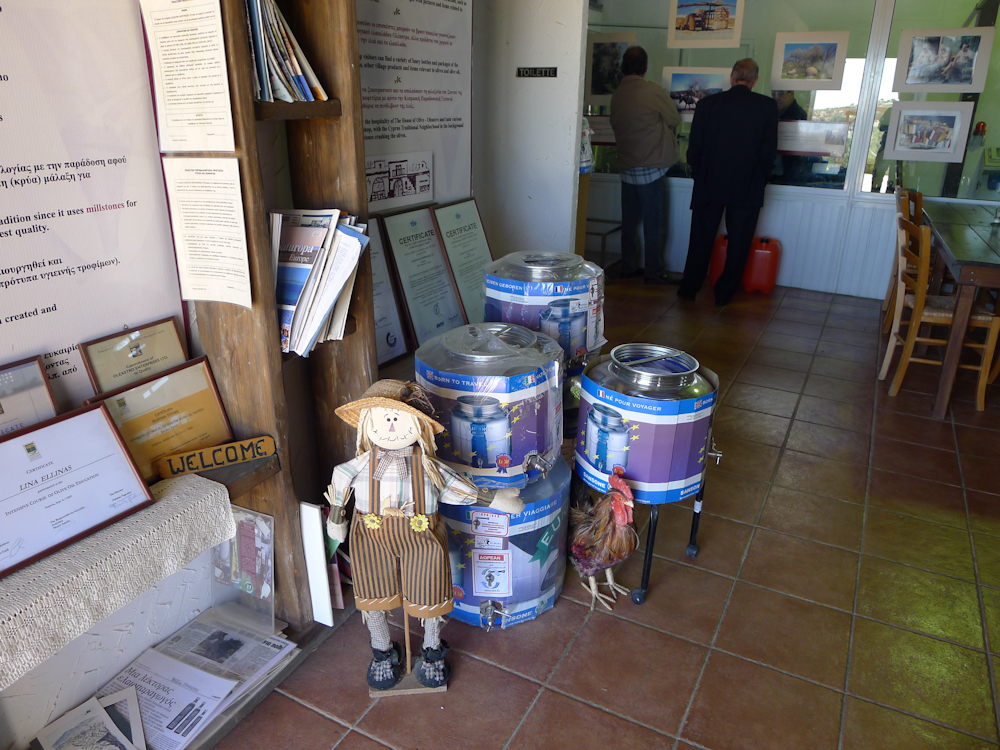
Anogira is the only press in Cyprus that uses millstones
to grind the olives.  They also have a museum and a
small cafe.

Andreas starts my olives' oil.

The two guys behind me in the queue.  The mill was quieter
this year than last -- maybe it's still early.

Tuesday, October 20, 2009

At The Olive Mill

Theodora and her crew filled fifteen boxes. Each box holds a little over ten kilos, so I knew that we had around 150 kilos and decided to press them at Anogira. I called the mill and confirmed that I could be the first through the press on Saturday morning. “Be there at nine, sharp!” Andreas said. Although each farmer’s fruit is theoretically kept separate, because ours is certified organic I like to be the first through the press. Being first means that you know, beyond any doubt, that your oil will come from your olives – and although it wouldn’t affect our certification, I like to be able to tell my customers that their oil is 100% certified organic olive oil.

So, leaving Best Beloved to take Leo and Sophia to Drama, I drove up to Anogira with Zenon.

We arrived bang on nine and I backed the Land Rover up to the hopper and Zeen and I started emptying the boxes. We had 168.9 kilos.

Olive pressing takes more than 2 hours. First the leaves are separated out and the olives are washed, then the fruit is crushed by the three giant wheels. After crushing the olives are kneaded in the machine, and the oil is extracted, finally trickling down into our containers.

We hadn’t had breakfast, so Zeen and I decided on a little snack to help the time pass. We chose toasts drizzled with oil and sprinkled with rigani. Mine came with tomato and feta and his was plain. And Zenon was hooked. A normally picky eater, he took one bite and his eyes lit up. “Can I have this at home every day?”

After our snack, we took a walk around the park that forms the museum part of the mill. I would recommend a visit here to anyone who is interested in learning about Cyprus or oil production. Andreas and Lina have created a beautifully landscaped park with attractive and interesting exhibits about the history and cultivation of olives. They have a model ‘old time’ press showing how donkeys were used to turn the screw; they have a collection of tools, utensils, mats, and pots. They have clear multi-lingual explanations.

But I think they’ve gone a little over the top. Where they’ve stuck to olives, everything’s great. Why add the sheep? I guess that you can say that sheep are a part of traditional Cypriot culture. A pony? The poor thing, a skewbald Shetland-cross, was disconsolately cropping coarse straw in his pen, waiting to be saddled and led around under tots all day (2 Euros a pop). I was hot, in shorts and a tank top. God knows how he felt in his woolly coat. Shetlands are bred for the inhospitable rocks of northern Scotland, not the sun-scorched Cypriot lowlands.

But saddest was the deer, in its faux-concrete pen. Young enough to still have spots, she pressed herself, flanks heaving, against the wire as far from us as she could possibly get, and stared with wide, dark brown eyes. When we moved, so did she, gauging her moment and leaping up the concrete rocks on fine-drawn legs to press herself against the other end of the pen. Her eyes never left us. There was nowhere she could hide. We put a Euro in a slot and watched a fan blow detergent foam ‘snow’ across the pen for a minute or so. Deer were here from pre-historic times until the mid-16th Century, but are no longer part of the native fauna. Maybe bringing one and creating an exhibit called ‘Snowfall in Troodos’ at an olive park was simply an exercise in wishful thinking.

By the time we had arrived back at the mill, other farmers had arrived and started their pressing. We sat around, chatted a bit, read some stories, then watched as our oil, bright green, started flowing out of the tap. We had about 27 litres – less than I expected. Less than I had hoped. But acidity at 0.4% puts it well into the Extra Virgin category, and the taste is fresh and peppery.

“Don’t sell it this year, Manamou,” Best Beloved said when I finally got home. “It has cost us 7 Euros a litre to produce this year, and you’ll not make anything on it. Keep it for us.”

Besides, if Zenon stays true to his wish and eats olive oil toast every day (and he has so far), we’ll need every last drop.

Sunday, May 10, 2009

Musings on an Evening in Late Spring

Every evening when Best Beloved is at home, he and I sit out on the back verandah with our wine. Sometimes we talk. Sometimes we don’t. Sometimes we argue. But at least some of the time we look out over the valley and down to the sea in silence.


The view has changed these last few weeks. No longer green, the meadows and plateaux are pale gold with ripening wheat and barley. Within a week we should see the tractors making their slow crawl, leaving swathes of cut grain that will be gathered into great rolls and loaded onto trucks.


Bright green has retreated, olive has returned. Slight humidity has brought a haze that hangs lightly over the land and blurs the once-sharp horizon. The sea has gone from blue to grey.


Last week we watched while eight hysterical hounds chased a hare across the opposite hillside, eventually losing him when the hare, with complete aplomb, zig-zagged, doubled back, and dived into a thicket of lentisk. This evening, there’s no such mad activity. Someone’s exercising their dogs on the slope, but the occasional clanging of the dogs’ bells is the only sound that alerts us to their presence.


We have started watering the olive trees. Last year the crop was poor -- plenty for us, but no excess to sell. But last year we had water cuts following poor rainfall and I was being stingey. We are also minding the field trees better this spring– applying zinc and iron through the watering system, spraying (at least Best Beloved is – after last year I washed my hands of it) M-Pede on aphids and sulphur on the mangoes. We think that there are some micronutrient deficiencies – apparently the inspector said that they were short some things, but I missed that part of the conversation because of my poor Greek.


This evening we are happy. Alex is off camping with his class in Polis (‘Getting pissed with his mates,’ Best Beloved intoned); Zenon and Leo are staying overnight with Matthew and Thomas in honour of Matthew’s eighth birthday (‘Do cleo and Chris know what they’re getting into?’ he wondered); Sophia is stuck to the computer, her nose in MSN.


I’m happy because I got so much done today. L, the Nepalese helper (he’s happy, or at least his father is because after 16 years with the Gurkhas he now has not only right of residency in the UK, but the pension and medical benefits that someone who has put his life on the line for Britain deserves) came today and together we cleared for a new double line of hoses, laid the hoses and the plastic mulch, planted 72 new cucumber vines and at least that number of green and purple beans, and cleared all the weeds out of the side garden, ready for a new round of cultivation and planting.


Best Beloved and I had a celebratory dinner: scallops perfectly cooked in butter and finished with a splash of cream, served with saffron pasta. The Condrieu matched them perfectly, and we smiled and held hands. Kay had suggested that we go out, but I don’t like going out for dinner. I can’t drink, because I drive, and I get ansty paying out for food that’s not as nice as we can make.


And nowhere has the view.